Community Notes, Local Events, PRA

Paint the Town

By Gerald Sharp, PRA Treasurer (with help from the QR code information on the various forms of art available at the exhibition)

This past Labor Day Weekend, the Kensington Armory hosted this year’s Paint the Town art show and sale.  In the mid-1980’s “Art in the Park” was first started, displaying paintings in the gardens.  In 1987 the show was renamed “Paint the Town” with cash prizes, and it became part of Kensington’s Labor Day festivities.  In 1995, some 30 years ago, the show was expanded to its present three-day format from Saturday through Labor Day on Monday, and the show was moved indoors to the Kensington Armory. 

This year, works of art in several categories (Abstract, Kensington, Portrait, Sculpture, Still Life, Landscape, and Photography) were exhibited and sold over the three-day holiday.   Plein Air paintings, usually landscapes, that must be fully painted outdoors without photographs to take into account outdoor lighting, were completed Saturday and were also presented (often still wet) and sold during the show.  The live aspect of this part of the show keeps artists honest in that they cannot just call any landscape they paint “Plein Art”. 

The largest prize each year is the Bertha Clum award for the best in the Kensington Category, paintings that are limited to Kensington landscapes. 

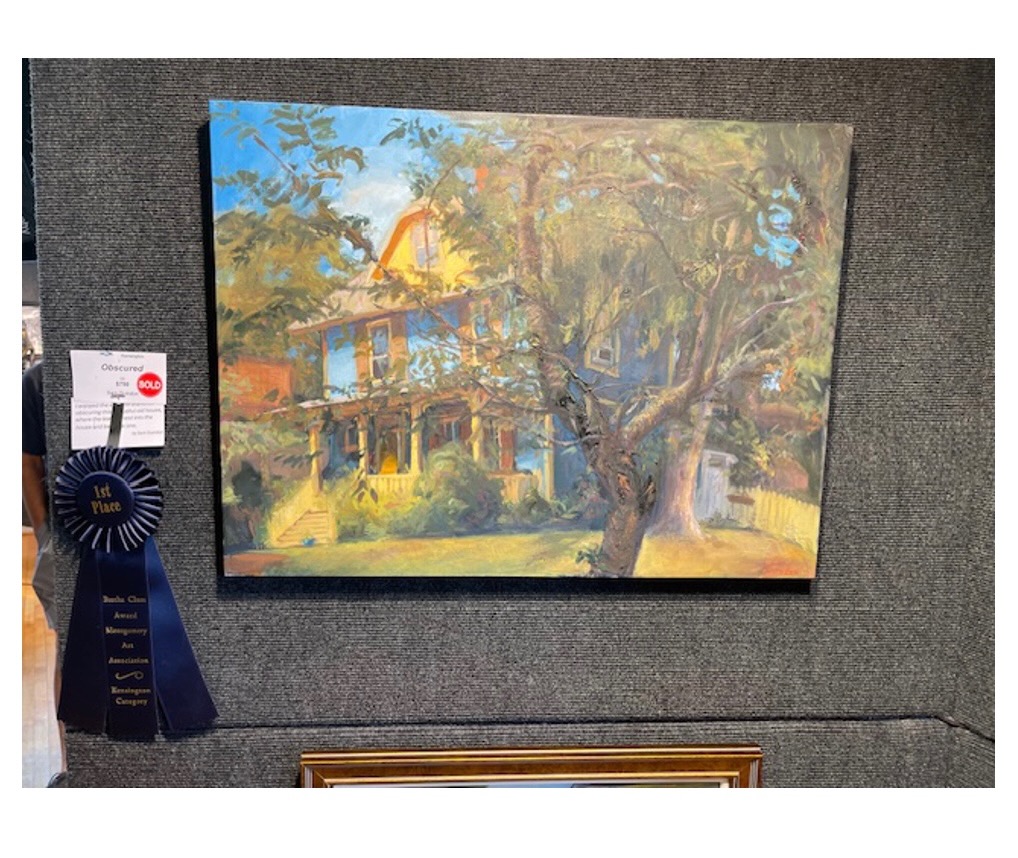
This year’s grand prize winner in the Kensington category was Sam Guindon’s “Obscured”, where the branches obscured this old house in Kensington.

Landscapes are defined as pictures showing natural or man-made scenery.  For example, they may show mountains, forests, beaches, skies, skyscrapers, and cities.  This show had a couple of paintings of cars that were classified as landscapes.  The main idea is that the setting is beautiful or interesting.  Landscapes greatly outnumbered the other categories of pictures at the exhibition.

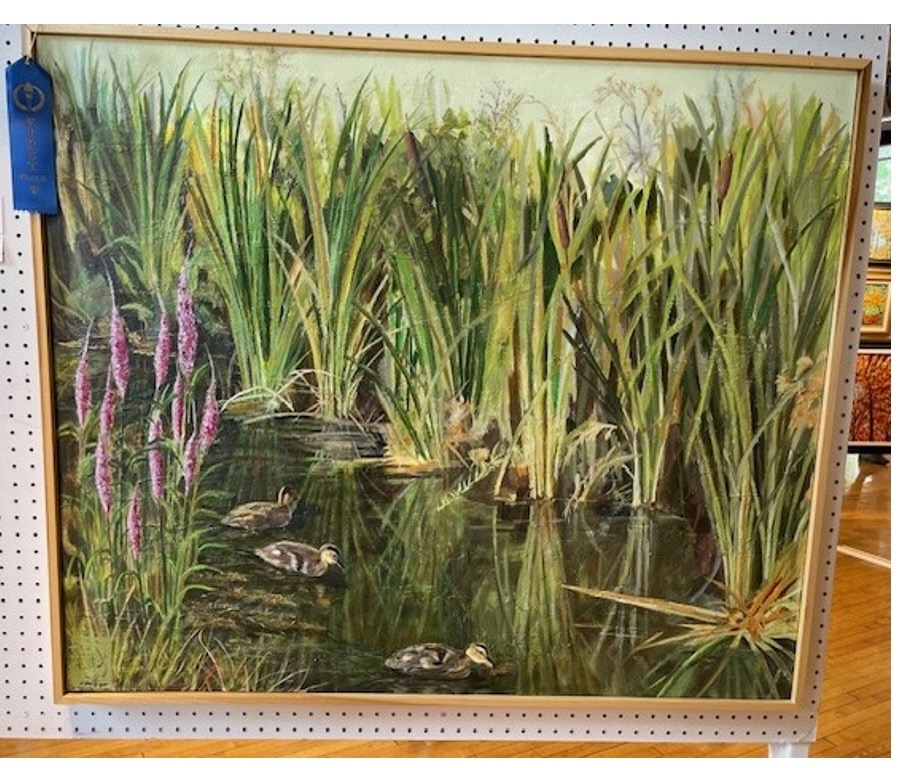
First Prize winner in Landscapes:  “No Rush in the Weeds”, an acrylic painting by Christina Haslinger.

To view Gerald’s entire report, including the winners in each of the other categories, go to this link.

AHS, Housing, PRA

The Pattern Book

This article, prepared by the PRA AHS Committee, describes the Pattern Book as proposed in the Attainable Housing Strategies initiative which is being considered by the County Council. Previous articles covered the initiative’s Goals, the Impact on Types of Homes in Parkwood, and Priority Housing Districts. Please note that our Committee aims for objectivity and neutrality. Therefore, much of the text of this article is composed of direct quotes from the final report on the initiative.

The Planning Board recommends creating a Planning Board-approved pattern book, to which conformance will be mandatory for the creation of new small scale attainable housing, whether through new construction or renovations to existing structures (emphasis added). The Pattern Book would apply to duplexes, triplexes, and quadplexes that could be built in Parkwood.

“The pattern book will be developed separately from the zoning recommendations through a process that will provide additional opportunities for community and stakeholder input. Work on the pattern book will proceed concurrently with the drafting of any zoning and subdivision text amendments based on direction from the Montgomery County Council.”

Because “the pattern book will be a complementary document to the development standards in the zoning ordinance, the Board recommends using a pattern book as part of the building permit process …to ensure clear and objective form-based standards.”  Montgomery Planning and the Department of Permitting Services will partner to create a review process to ensure applicable development projects conform.” [pp30; dp31]

“The pattern book would apply to new construction … of standard method duplexes in the R-200, R-90, and R-60 zones, and new construction of standard method multiplexes in the R-90, R-60, and R-40 zones” [pp27; dp28**]. Parkwood is zoned R-60. Based on the criteria for “new construction” [see definition below], the proposed Pattern Book would evidently not affect additions or other changes to a single-family home remaining as a single-family home. 

“The form-based standards within the pattern book will ensure that duplexes, triplexes, and quadplexes contribute positively to the public realm and create safe and attractive streetscapes that are not overwhelmed by parking or that unintentionally look like small apartment buildings.

“The pattern book will also ensure elements like porches, stoops, and lead walks are included to create neighborly homes that encourage social interaction and do not lead to isolating community dynamics. Finally, the pattern book will help eliminate arbitrary terms such as ‘character’ and ‘compatibility’ from the evaluation criteria for these duplex and multiplex building types and will rather focus on specific standards that achieve these more ambiguous goals.

“The pattern book will not dictate or restrict architectural styles, design choices, building materials, or colors. These creative choices will be the purview of the architect and/or homeowner. The pattern book will provide clear regulatory guidance with some conceptual options but will not create cumbersome mandates related to design. Thus, while allowing ample creative freedom, the pattern book will provide clear guidance to the architects and/or homeowners to construct house scale duplex and multiplex building types regardless of the size of the lot.” [pp28; dp29]

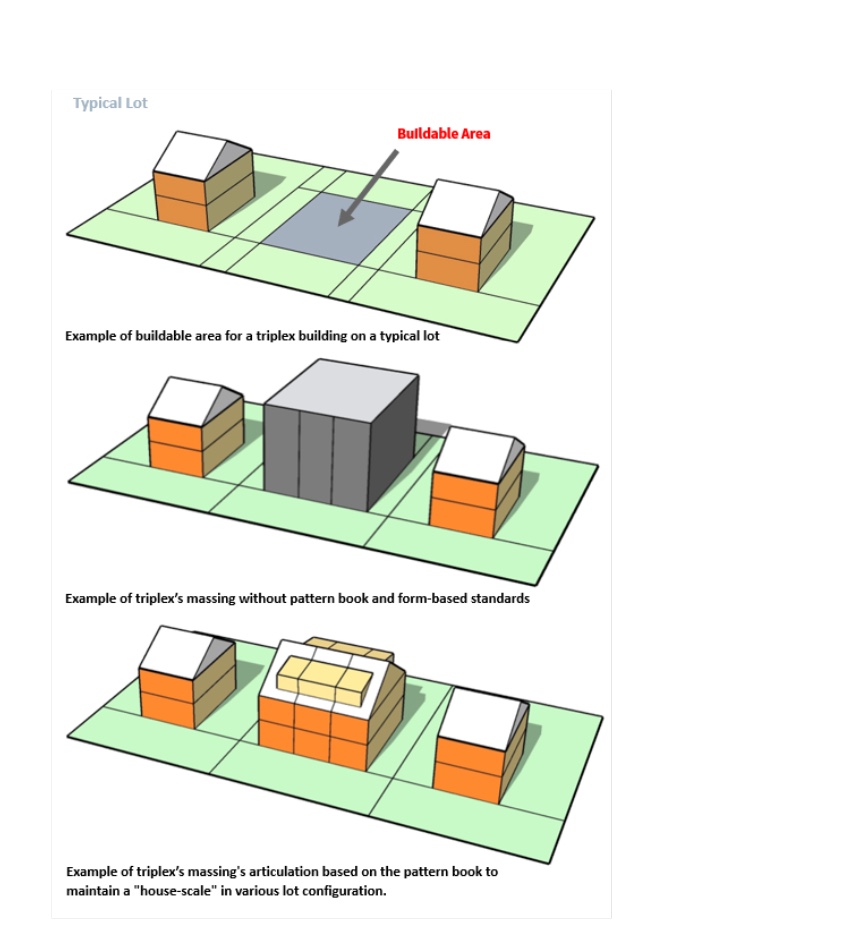
“Below is an illustration showing the development of a triplex on a typical lot found in many of the county’s neighborhoods. The first image shows the regulated buildable area, and the second image shows the “box” that can be built on the lot while adhering to typical regulatory requirements such as setbacks, lot coverage, and height. As demonstrated, the building envelope can create vastly different and potentially suboptimal results without form-based-standards [such as those in the Pattern Book]. The third image shows how the addition of some minimal form-based guidance (i.e., the Pattern Book) can create vastly superior outcomes.” [pp28; dp29]

The next article in this series will discuss how market factors might affect the rate at which single family homes would be turned into multi-unit houses if the AHS proposals are approved.

**************************************************

“Definition of new construction:  “A new building, the demolition, and reconstruction of more than 50 percent of the floor area of an existing building, or the addition of more than 50 percent of the floor area to an existing building.” [pp27; dp28**]

** Throughout this and subsequent articles, two page numbers will be used as references to the text of the Planning Board’s Final Report to the CouncilThe letters “pp” will refer to the printed page number of the report.  The letters “dp” will refer to the digital page number of the report in PDF format.

AHS, Housing, PRA

Priority Housing Districts

This article, prepared by the PRA AHS Committee, describes Priority Housing Districts [PHDs] as proposed in the Attainable Housing Strategies initiative which is being considered by the County Council.  Previous articles by the PRA AHS Committee covered the initiative’s Goals and the Impact on Types of Homes in Parkwood. Please note that our Committee aims for objectivity and neutrality. Therefore, most of the text of this article is composed of direct quotes from the final report on the initiative.

The Planning Board recommends establishing Priority Housing Districts, in which, in addition to duplexes and triplexes, quadplexes would be allowed with reduced parking requirements. The Board recommends “…defining the Priority Housing District using a straight-line buffer of one mile from Metrorail’s Red Line, the Purple Line light rail, and MARC rail stations… “[Emphasis added. See map pp21; dp22**].

Based on the criterion of a one mile “straight-line buffer [i.e., boundary line]…” from Metro and MARC rail stations, at least some portions of Parkwood would be within a Priority Housing District. This has several implications for housing in our community: specifically,  1) quadplexes could be built “by right” and 2) parking requirements would be reduced.  [See explanation of “by right” at the end of this article.]

Standards for quadplexes.  Although quadplexes could be built “by right”, they would have to “…comply with the elements of a pattern book [an article on the Pattern Book is forthcoming]. A primary goal of the pattern book is to facilitate the construction of duplexes, triplexes, and quadplexes that maintain a house-scale size and form…The pattern book will also ensure elements like porches, stoops, and lead walks are included to create neighborly homes that encourage social interaction and do not lead to isolating community dynamics.”[pp27-28; dp28-29**]

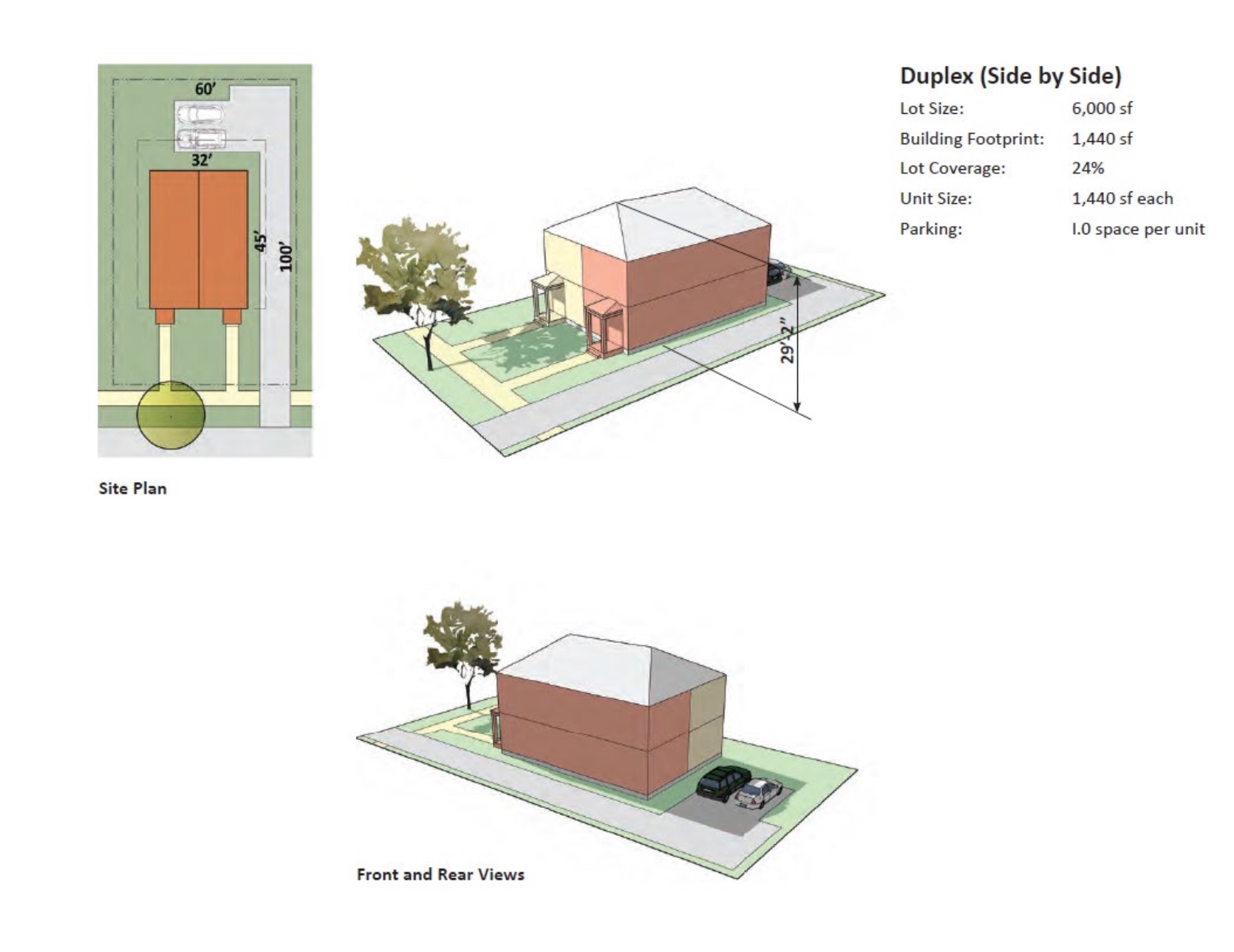
Here are examples of two different types of duplexes that would be allowed: [pp87&89; dp88&90**].

Parking.  “As part of the AHS, a review of the parking requirements…was conducted [by the Planning Department]. One of the areas of focus was on the required minimum parking that is appropriate for attainable housing dwellings, and whether that should vary based on the dwelling type, or the location of the housing. Part of what informed the Board’s recommendations included the work done in 2018 on Accessory Dwelling Units where the council agreed to reduce parking requirements within a mile of transit or where adequate on-street parking was available (emphasis added). In addition, the priority of facilitating more intensive attainable housing (quadplexes) and generally reducing overall parking near existing and planned transit through the Priority Housing District was considered….A review of professional literature on parking in various other jurisdictions suggests that parking requirements contribute to the high cost of housing” (emphasis added.) [pp42-43; dp43-44]

“Buffer Distances”. The Planning Board reports that “Several people believe that the …distances used to create the Priority Housing District are arbitrary and random – and either smaller buffers or pedestrian network walksheds should be used as a more realistic option. (emphasis added) The Planning Board felt that it was consistent to align the buffer distances with previous guidance from the Accessory Dwelling Unit parking requirements, which included 1-mile straightline buffers.” [pp63; dp64**]

Summary:  Based on the current definition of a Priority Housing District [within one straight-line mile of a Metro or MARC station], at least some portions of Parkwood would be within a PHD.  This would allow quadplexes to be built “by right” and parking requirements to be reduced.  Questions have been raised about the reasonableness of the one-mile boundary, but the Planning Board is currently maintaining its proposed criterion.

The next article in this series will be a description of the proposed Pattern Book.

***************************************************

Explanation of “by right”:  Property owners can build what and how they want as long as the units are within then-current zoning ordinances without having to apply for a zoning variance, unless it exceeds the restrictions of those ordinances. If the proposed Pattern Book is adopted by the Council, quadplexes, as well as duplexes and triplexes, would also  have to conform its requirements.

 ** Throughout this and subsequent articles, two page numbers will be used as references to the text of the Planning Board’s Final Report to the CouncilThe letters “pp” will refer to the printed page number of the report.  The letters “dp” will refer to the digital page number of the report in PDF format.
AHS, Housing, PRA

IMPACT ON TYPES OF HOMES IN PARKWOOD

This article, prepared by the PRA AHS Committee, discusses the types of housing proposed in the Planning Board’s Attainable Housing Strategies Final Report for neighborhoods such as Parkwood that have a zoning designation of R-60.  

If the regulations proposed in that report are approved by the County Council without amendment, then duplexes, triplexes, and possibly quadplexes would be permitted in Parkwood, in addition to single family homes.  Quadplexes would be permitted if Parkwood is determined to lie within a Priority Housing District (PHD) as currently defined, i.e., within a straight-line mile of a Metro or MARC station.  [More about PHDs in a forthcoming article.] 

The Planning Board also recommends creating a new optional method of development called the Attainable Housing Optional Method (AHOM) to provide opportunities for medium scale attainable housing such as stacked flats, small townhouses, and small apartment buildings on certain properties in R-60 zones that are within 500 feet of Thrive Montgomery 2050 -designated Growth Corridors . However, it seems unlikely that these additional  types of dwellings, i.e., stacked flats, etc. would  be permitted in Parkwood because it is not within the Growth Corridor boundaries. [pp31-32; dp32-33 **].   See this map of Growth Corridors.

Also of note is that the Planning Board is not recommending allowing the AHOM in R-200 zones, many of which are in wealthier communities, because the R-200 zones are generally  located outside of the corridor-focused growth areas identified in the Thrive report .  They are instead located in limited growth areas. [pp32;dp33**].  In addition, triplexes and quadplexes would be allowed only in R-200 zoned areas that were in Priority Housing Districts.  These limitations on what can be built in many R-200 zones have caused some residents to consider these constraints unfair in comparison to what can be built in R-60 zones such as Parkwood.

Finally, Parkwood would not be considered for “large scale” attainable housing developments, which include four- or more story, mixed-use live/work buildings, stacked flats, and small apartment buildings, again because it is not within one of the Thrive designated Growth Corridors. Given the larger impact and scale of these attainable housing types, the report states that this type of housing is most appropriate to be implemented after the full analysis and public engagement of either a local master plan process or a Local Map Amendment (LMA) process.[pp36;dp37**]  

In summary, if the Council adopts the currently proposed zoning changes, then duplexes and triplexes would be permitted in Parkwood, along with single family homes.  Quadplexes would be permitted if the Council agrees to the boundaries as proposed for Priority Housing Districts. However, stacked flats, small townhouses, small apartment buildings, and other large scale attainable housing developments would not be permitted.

The next article in this series will describe Priority Housing Districts.

******************************************

** Throughout this and subsequent articles, two page numbers will be used as references to the text of the Planning Board’s Final Report to the CouncilThe letters “pp” will refer to the printed page number of the report.  The letters “dp” will refer to the digital page number of the report in PDF format.
AHS, Housing, PRA

Goals of the Attainable Housing Strategies initiative

This article, prepared by the PRA AHS committee, describes the goals of the proposed Attainable Housing Strategies and the problems it is designed to solve. 

A shortage of housing and especially affordable housing is the most important and most frequently cited challenge the plan is intended to address.  The goals also include:

  • Increasing the diversity of the County’s housing supply.
  • Meeting economic development objectives.
  • “Unraveling” the exclusionary aspects of the County’s single family home zoning.
  • Creating more opportunities for more home ownership for more households in more parts of the county.

The cost of housing is a major problem.  “Housing has become less affordable in all parts of Montgomery County. In 2023, the average detached home sales price was $968,522 – an increase of three percent from the 2022 average. This was not an outlier, as year-to-date in 2024 (January through April) the average detached home sales price increased by approximately $50,000 to over $1,000,000.

“In all zip codes in Montgomery County, home prices have increased above the rate of inflation and outpaced income growth since the mid-1990s. … Neighborhoods that were once considered relatively affordable are now only affordable to households earning well above the median income.” [pp12;dp13**]

“If the trends are not addressed, the disparities between those who can and cannot afford to buy a home in the county will continue to grow. Given the historical inequities associated with homeownership, those disparities will continue to segregate Montgomery County communities along racial, ethnic, and economic lines.”  [pp15;dp16**]

However, the actual shortage of housing in the county, attainable, affordable, or otherwise has become a matter of debate. While there is data, noted above, showing that in the last several years the cost of housing has risen faster than the increase in income, there is some disagreement about the extent of the reported “housing shortage”.  The Metropolitan Washington Council of Governments has said the county needs many more thousands of houses to meet demand in the next several years.

On the other hand, the County Executive notes that this need has declined in the past two years and reports that enough housing permits under current zoning have already been granted to meet that need.  If the latter is true, will the proposals encourage those with permits to begin building?  And will that housing be more attainable or affordable than the current market offers?

Some County leaders have expressed strong support for the need to solve the housing challenge. 

Council President Friedson, for example, has said that “We face a severe housing shortage in Montgomery County which requires thoughtful, forward-looking action. Finding a home that meets the evolving needs of our residents and families has become increasingly out of reach.” 

Planning Board Chair Artie Harris has stated that “The time has come for Montgomery County to break free from outdated zoning that has constrained the housing supply, led to skyrocketing real estate prices, and has forced more of the County’s middle-income population to search elsewhere for housing. The County has little open land left to build on and almost half of the County’s housing stock is composed of detached housing.” 

However, County Executive Elrich, while agreeing with the need for more affordable housing has questioned whether the proposals in the Planning Board’s plan are the best way to meet that need.

Summary:  Rising costs have made housing unaffordable for many residents in many parts of the county. The Attainable Housing Strategies initiative currently before the County Council is intended to meet the need for more attainable and especially more affordable housing, while also addressing other goals such as economic development and more opportunities for home ownership for more households.  There is debate, however, over the extent of the actual housing shortage and whether the proposals in the Attainable Housing Report are the best way to meet its goals.

The next article in this series will discuss the types of housing recommended and not recommended  for neighborhoods such as Parkwood.

** Throughout this and subsequent articles, two page numbers will be used as references to the text of the Planning Board’s Final Report to the CouncilThe letters “pp” will refer to the printed page number of the report.  The letters “dp” will refer to the digital page number of the report in PDF format.

AHS, Housing, PRA

Background information on the Attainable Housing Strategies initiative

This article describes the forthcoming information articles the PRA AHS committee will begin publishing on the Attainable Housing Strategies Final Report which the County Council will take up when it resumes sessions in September.

As noted in a previous PRA News article, the County Council has scheduled five in-person and one virtual session on the Attainable Housing Strategies [AHS] initiative which is likely to result in zoning amendments intended to increase the supply, affordability, and diversity of housing in the county.

As background for these listening sessions and the zoning amendments the Council will likely consider, the PRA AHS Committee will provide a series of brief articles that explain the potential impact on the Parkwood community, raise questions that require clarification, and identify important issues that need to be resolved.  As stated previously, the articles will be as neutral and objective as possible, intended to provide useful information to residents, but will not state a position for or against any of the proposals in the report of the Planning Board.  These articles will appear in PRA News on the listserv.

Among the topics to be discussed in these articles are the following:

  • Goals of the AHS proposals:  What are the problems the AHS initiative is intended to solve?  What has happened to the cost of housing in the county?  What is the actual extent of the  housing shortage?
  • Potential effect on types of housing in Parkwood:  What types of houses would be permitted/not permitted in Parkwood?  
  • Market factors:  How might market factors affect the rate at which single family homes would be turned into multi-unit houses if the AHS proposals are approved?  What is the number of multiplexes [duplexes, triplexes, etc.] projected to be built in communities like Parkwood? 
  • Possible impact on the value of homes in Parkwood.
  • Explanation of Priority Housing Districts and Growth Corridors, whether they would apply to Parkwood, and if so, how.
  • Explanation of the Pattern Book, which will provide mandatory guidance on the design of duplexes, triplexes, and quadplexes.
  • Important issues that need further clarification, such as stormwater management, parking, and impact taxes.
  • Discussion of the likelihood the AHS proposals will be able to meet the plan’s objectives, based on experience of other jurisdictions, research reports, etc.
  • Potential limitations to upzoning: restrictive covenants, municipal control, litigation.
  • How to express your opinion to the Council.
  • How to learn more: Notices about speakers,  meetings with experts, etc.
  • Council schedule for review and implementation, to be updated regularly.

The next article in this series will describe the goals of the Attainable Housing Strategies initiative.

AHS, Housing, PRA

County Listening Sessions on Attainable Housing Strategies

As reported in a Montgomery County press release, Council President Andrew Friedson and Montgomery Planning Director Jason K. Sartori are inviting community members to attend five in-person and one virtual listening sessions on the Attainable Housing Strategies initiative (AHS).  The initiative would allow property owners to have the option to build a wider range of housing types in areas of the County that for decades have only allowed one single-family detached home per lot. See further comments at the end of this article regarding the purposes of the AHS initiative.*

There is no legislation to implement Attainable Housing Strategies currently pending before the Council. The purpose of the six listening sessions is to collect feedback on the Planning Board recommendations which will be shared with all Councilmembers as part of a deliberative review process.

Use this link to sign up for a listening session. Please note that there is a deadline for signing up for each session.

The Council is also inviting residents to provide additional feedback on the Attainable Housing Strategies initiative. 

The six listening sessions will be held in each of the County’s five regional service areas, followed by a virtual meeting. The five in-person events will be held from 7 to 9 p.m. The virtual session will be held on Oct. 2 from 12-1:30 p.m.

The listening sessions are scheduled on:

  • Wednesday, Sept. 11, from 7 to 9 p.m. at the Silver Spring Recreation and Aquatic Center (1319 Apple Ave., Silver Spring, MD). Sign up by Sept. 9, 12:00 p.m.
  • Thursday, Sept. 12, from 7 to 9 p.m. at the Wheaton Community Recreation Center (11701 Georgia Ave., Wheaton, MD). Sign up by Sept. 10, 12:00 p.m.
  • Tuesday, Sept. 17, from 7 to 9 p.m. at the White Oak Community Recreation Center (1700 April Lane, Silver Spring, MD). Sign up by Sept. 13, 12:00 p.m.
  • Monday, Sept. 23, from 7 to 9 p.m. at the Germantown Community Center (18905 Kingsview Road, Germantown, MD). Sign up by Sept. 19, 12:00 p.m.
  • Wednesday, Sept. 25, from 7 to 9 p.m. at the Bethesda-Chevy Chase Regional Services Center (4805 Edgemoor Lane, Bethesda, MD – Wisconsin Room). Sign up by Sept.23, 12:00 p.m.
  • Wednesday, Oct. 2, virtual on Zoom 12-1:30 p.m. Sign up by Sept. 27, 12:00 p.m.

*According to CM Friedson, “We face a severe housing shortage in Montgomery County which requires thoughtful, forward-looking action. Finding a home that meets the evolving needs of our residents and families has become increasingly out of reach. I look forward to hearing a variety of perspectives and ideas from our residents, so we can work together to build on the recent progress we’ve made and refine solutions that support the type of communities and the quality of life we’ve come to expect in this great County.”

Planning Board Chair Artie Harris has stated that, “The time has come for Montgomery County to break free from outdated zoning that has constrained the housing supply, led to skyrocketing real estate prices, and has forced more of the County’s middle-income population to search elsewhere for housing. The County has little open land left to build on and almost half of the County’s housing stock is composed of detached housing. People of all ages and income levels need more choices to bridge the gap between high-rise apartment buildings and single-family detached houses. We can no longer afford to devote so much land to so few people.”

Montgomery Planning Director Sartori notes that “Montgomery County supports strong, inclusive communities and its zoning laws need to align with its commitment to fostering the creation of communities where not just the most fortunate can own a home and build wealth.  These recommendations not only outline different housing types to add to our housing stock but create options and opportunities for households of various incomes to attain housing that is suitable to their needs.”

AHS, Housing, PRA

Council Committee Work Session #3 on Attainable Housing Strategies.

On July 22, 2024, the County Council’s Planning, Housing, and Parks [PHP] Committee held its third Work Session [WS] on the Attainable Housing Strategies [AHS] report submitted by the Planning Board to the Council on June 14.  [Ed note: These notes were prepared by Clare Murphy, a member of the PRA AHS committee.]

As in the first two Work Sessions, the three committee members participated in the meeting: Andrew Friedson, Committee Chair and President of the Council; Will Jawando (via zoom), At Large Council Member [CM]; and Natali Fani-Gonźalez, District 6 CM. The Committee expects to make final recommendations to the full Council in the fall.

As in past sessions, the WS was led by members of Council staff, including its Legislative Attorney and Legislative Analysts who presented their assessment of the last three sections of the Planning Board’s report.  Staff gave their suggestions to accept Planning’s proposals or to make changes to them. Planning Board and Department employees were there and provided clarification and information when asked by Committee Members or staff.

 The July 17th Memorandum from the committee staff to the committee members details the Report sections discussed at this WS.

Planning Report Sections Discussed:

  • Large Scale Attainable Housing [AH] – four-story [or more] mixed-use, live/work buildings, stacked flats, and small apartment buildings. Planning recommended and Council staff agreed to use the master plan process to identify opportunities to rezone properties along the Growth Corridors for higher intensity residential development. [Ed note: This could include portions of Parkwood.]
  • Plan Reviews and Subdivision Process. – Planning recommended and Council staff agreed to revise site plan reviews for some large scale development and to streamline subdivision approval process for projects of 19 or fewer units. This included allowing some projects without frontage.
  • Parking. Planning recommended and Council staff agreed to several plans to reduce the minimum parking requirements for AH development but stressed that there’s no prohibition to providing more parking. CM Friedson stressed that parking is a big issue with residents and should be further reviewed.
  • Residential Driveway Standards. Planning recommended establishing narrower widths for AH projects. CM Friedson questioned this recommendation and suggested that Planning get more data on latest construction projects.
  • Street Trees and Tree Canopy. Planning recommended exploring ways to reduce tree spacing in the right of way. CM Friedson said this issue needs a “deep dive beyond AH” and needs to be analyzed further.
  • Fire and Rescue Standards. Planning is concerned that Commercial Standards, which are stricter than residential, will be applied to AH multiplex projects, thereby reducing the number of housing units built.  
  • Storm Water Management. Planning recommends updating the current code to require SWM for multiplex buildings. [Ed note. There wasn’t much discussion on this topic.]
  • Catalyst Policies and Programs. Planning recommended several programs to incentivize homeowners to convert their properties to multiplexes, such as tax refunds, loans, and development of a “toolkit”. CM Friedson said this issue is much broader than zoning and should be removed from the AH plan. He said it’s an economic issue. CM Fani-Gonzalez said it will be addressed soon.
  • Impact Taxes. Planning noted that minimizing taxes on AH projects will “accelerate” production of them. This matter will be addressed at the Council’s 2024-2028 Growth and Infrastructure Policy this fall.
  • HOAs and Municipalities. Council staff and CM Friedson stressed that the County can’t override these entities’ zoning controls. They suggest exploring ways to remove prohibitions to AH and to educate municipalities on AH.  [Ed note.  There was a lot less emphasis on getting the State to address these issues than there had been in earlier Work Sessions.]

Council Members’ Questions and Concerns

  • CM Jawando attended via zoom and didn’t make any comments or ask any questions.   
  • CM Fani-Gonźalez made a few comments and didn’t ask any questions.
  • CM and Committee Chair Friedson led the Work Session and asked a lot of questions of the Council staff and Planning employees.

Next Steps

  • The Council plans to hold a series of “listening sessions” in the fall of 2024 to obtain additional feedback from stakeholders. After consideration of input from these work sessions and public listening sessions, proposed legislation is expected to be transmitted by the Planning Board to the Council to implement the various recommendations and zoning changes.
  • The Council will also conduct public hearings and hold further work sessions to review the legislative proposals before enacting any changes. More details on this schedule will be available in the coming weeks.
  • Planning started its three-part “Speaker Series’ on July 18th. Two others are scheduled for Sep.19th and  Oct. 17th.  Most of the speakers are from communities that have implemented a form of AH, research organizations and developers.

AHS, Housing, PRA

Council Committee Work Session#2 on Attainable Housing Strategies (AHS)

On July 8, 2024, the Montgomery County Council’s Planning, Housing and Parks (PHP) Committee held its second Work Session on the Attainable Housing Strategies (AHS) report submitted by the County’s Planning Board on June 14th.  (See background at the end of this article.) As in the first Work Session, the same three members of the Committee participated: Andrew Friedson, Committee Chair and President of the Council; Will Jawando, At Large Council Member; and Natali Fani-Gonźalez, District 6 Council Member. The PHP Committee has scheduled one more Work Session with the Planning Department on July 22nd and expects to make final recommendations to the full Council in the fall.

The work session was led by members of the County Council staff, including its Legislative Attorney and three Legislative analysts.  They presented their assessment of certain sections of the PHP’s final report on AHS, either recommending that the Planning Board’s recommendations be accepted or changed.

Most of the presentation was made by the Staff Attorney Livhu Ndou with Senior Legislative Analyst Pamela Dunn answering questions of the PHP committee members and providing them with more details. At least five Planning Board and Department employees were there and were asked to provide clarification and information by Committee Members and Staff.

Major Report Sections Discussed –

  • Small Scale attainable housing: duplexes, triplexes and quadplexes all could be approved for Parkwood, which is zoned R-60.
  • Priority Housing District: designation, which allows quadplexes to be built within a mile of MARC and metro stations, an area which includes some portions of Parkwood. Committee members asked for a better description of this designation than what is in the current report and want to discuss it again. (Ed. note.  Perhaps this designation is considered one that can be easily challenged by residents.)
  • By Right” term was used often by staff as a means to allow a quicker approval process for AHS structures in areas currently zoned for single-family detached homes.  As I understand the term, it means that no special approval by the Planning Board or Planning Department would be required to build these structures in those areas. CM Friedson and other staff members emphasized that multiplexes would fit on current lot sizes, with the same set-back requirements for frontage and borders. Mr. Friedson said that multidwelling units will probably fit better on single family lots than some of the current “tear downs”.
  • Zoning Text Amendment (ZTA): As part of the ZTA process, Staff wants to change definitions of townhouses and apartment buildings to clarify their distinctions from multiplexes.
  • Additional Dwelling Units (ADUs): these were discussed in comparison with Attainable Housing multiplexes. One planning employee said he didn’t think ADUs would be needed after this new AHS is in place.
  • Medium Scale Atttainable Housing: This would be allowed in R-60 areas under certain circumstances, such as in growth corridors. The Attainable Housing Optional Method (AHOM) would allow townhouses and small apartment buildings to be constructed in R-60 zones

Pattern Book

The County Council hasn’t received a draft of a Pattern Book and wants one ASAP.  Planning Department  employees said producing a final PB might take a year.

Planning Department employees described it as “one stop guide”, and a “checklist” to having multiplexes approved by the County.  I think it’s primarily intended for developers as it will include detailed descriptions of structures, licensing and permit procedures. Planning Department staff said it could also be used by homeowners who want to convert their houses to multiplexes.

Pattern Books are being used in other jurisdictions, including DC; Santa Fe, NM; and New Orleans. (Obviously, these more urban jurisdictions have less in common with Montgomery County).

Council Members’ questions and concerns

  • CM Jawando reminded everyone that the current Attainable Housing Strategies Report proposes one way to make zoning changes, but there are other ways to accomplish that. (I’m not sure what he meant by that.)
  • CM Jawando asked about large investment development companies getting into Attainable Housing development in Montgomery County for profit and without regard for the current community. CM Friedson and Planning Department employees said they didn’t think there was any indication of this happening. One of the Planning staff members said that she had done a little research on developments in Arlington and hadn’t seen any indication of that type of investment. Planning staff and Mr. Friedson think that small, local builders will do the Attainable Housing development in the county, but it’s not clear how they know this since the proposed major changes in zoning have not gone into effect.  (Ed. note: It would be informative to see what has happened in similar communities that have made these kind of changes.  Also some local and regional developers could be considered “big investors”. If developers who care more about profits than the quality of living for residents are allowed to build and own rental properties in R-60 communities, this could have negative impacts on those communities.)  
  • CM Fani-Gonzalez said AHS is all about “opportunities for all people who want to live in Montgomery County”.
  • Council members asked about outreach to communities, because they’ve been hearing from residents and community groups. The Planning Department is keeping an unofficial record of stakeholders’ correspondence and answering enquiries. Jason Sartori, Director of the Planning Department, said his department will improve this process and keep the Committee in “the loop”.  The Committee Members are going to have public outreach sessions in the fall.  

Background:  In March 2021, the Council requested that the Planning Department undertake an effort to consider zoning reforms to allow opportunities for more diverse housing types in the county, to provide opportunities for public input, and to send recommended zoning modifications to the Council.

Subsequently, the Planning Department initiated the Attainable Housing Strategies initiative (AHS) to review, study, and identify various housing policy options. In 2021, a draft report was produced representing the findings of the early analyses and recommendations of the previous Planning Board. Since 2021, Planning staff has undertaken a thorough review of the prior analyses and recommendations with the current Planning Board. The Board sent a revised report containing updated analyses and recommendations to the Council on June 14, 2024. The recommendations contained in the study are intended as a guide for drafting future legislation. They represent a starting point for discussion with the PHP Committee.