By Joe Harkins, Co-Chair, Joint Housing Committee.
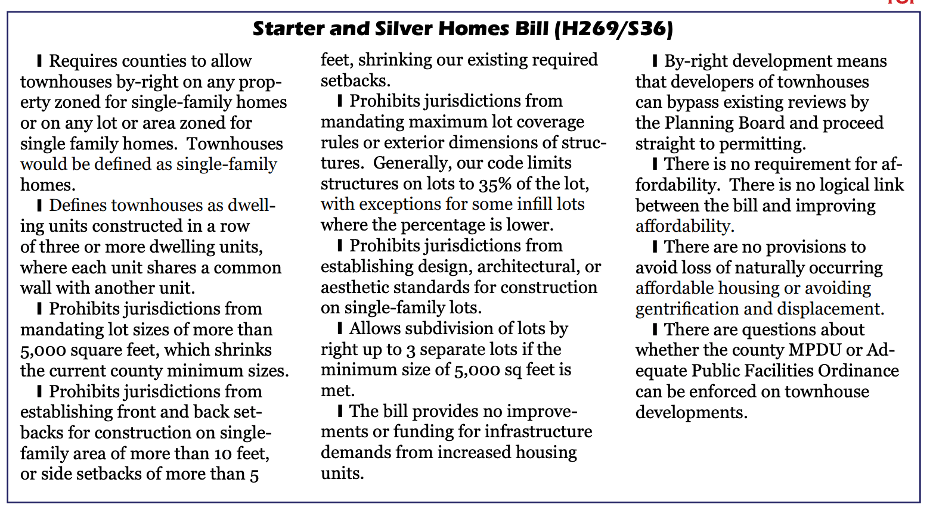
Governor Wes Moore’s far-reaching and controversial legislation, the Starter and Silver Homes bill, will not pass in this session of the Maryland General Assembly. SB 36 failed to advance in the Education, Energy and Environment Committee of the state Senate, and HB 239 failed to advance in the Economic Matters Committee of the state House of Delegates. As previously reported, if enacted, this bill would have pre-empted the fundamentals of local zoning law, such as the definition of single family houses (to include townhouses), minimum lot sizes, and current setback and height requirements.
The stated goal of the bill was to increase housing at lower cost through “densification,” as required by the state, but enforced by local governments. Generally, counties and municipalities throughout the state opposed the bill, as did Montgomery County Executive Mark Elrich, although our County Council took no formal position. House Speaker Joseline Pena-Melynk attempted to develop a compromise bill that could pass the House and be re-introduced in the Senate. This effort continued until recently, despite each chamber having missed Crossover Day (the conventional way bills pass both bodies). The Speaker’s efforts have now ceased, although the Governor’s Office is reported to be working on another version for next year’s legislative session. The 2026 session ends April 13th.
Two companion bills, also seeking to increase housing in the state, appear to be advancing toward final passage. The Maryland Transit & Housing Opportunity bill, SB 389/HB 894, aims to free up state-owned land for housing near rail transit sites, potentially adding an estimated 7,000 units in Maryland. As amended, the House bill passed second reading, the step immediately prior to passage, and the Senate bill will likely advance there, too. A conference committee would need to iron out any differences between the two bills as passed. The Housing Certainty bill, SB 325/HB 548, would allow developers to lock in building permit approval for three to five years (depending on the bill version). In effect, this prevents local governments from changing permitting requirements when construction is underway. Apparently, such changes are more common in counties other than Montgomery. These bills met Crossover Day requirements and appear likely to pass in the General Assembly this session.
Your Joint Housing Committee will continue to monitor any late-breaking developments in the legislature before April 13th. And, we likely will be reporting to residents on housing issues next year, as well.
The House and Senate committees assigned to review the Governor’s proposed housing legislation [See this News article for a description of the bills] heard from a variety of panels, each consisting of five organizations or individuals grouped into three categories in relation to the legislation: Favorable, Favorable with Amendments, and Unfavorable.
Before the hearings were held, the Department of Housing and Community Development [DHCD], which is managing the bill on behalf of the Governor, met with a variety of stakeholders and agreed to a number of important amendments to the original bills. [See this News article that summarizes major amdts.] Some testimony at the hearings might have been different if the witnesses had known about the proposed DHCD amendments. Many of the amendments addressed concerns raised by those testifying.
While all witnesses submitted written testimony, their oral presentations focused on the issues they considered most important. This summary is based on those presentations.
FAVORABLE
The position of the several departments supporting the legislation are listed here. Others testifying in favor of the legislation cited similar points.
Maryland has a housing shortage-builders have not built enough in last 15-16 yrs.
Gap is 100,000 homes, just for current population, according to DHCD.
Only 49 % can afford median price of home; down from 75% in the prior decade.
90% say cost of housing is too high
88% say cost of renting is too high
36% considering leaving MD because of housing costs
½ net domestic migration is 17-35 year olds
Housing and lengthy commutes are top two reasons for leaving
Seniors have no viable options for obtaining a smaller, affordable home and leave, according to DHCD
Solution that this bill supports: Build More Smaller Homes by Increasing Density
Town houses [THs] cost 1/3 less per square foot than existing single family homes [SFH], according to DHCD
Allow THs to be built in areas zoned for SFHs only
Limit required lot sizes
Allow owners to split lots
Have fewer requirements, require smaller setbacks, front, back, side
More houses will provide a “relief valve” from cost of renting-would allow more renters to move to homes, which would open more rental options too.
FAVORABLE WITH AMENDMENTS
Local authority must be preserved.
It is better for the state to set targets and work together with local governments to achieve housing goals and let locals meet the need.
Looser setbacks and more density allowance will encourage McMansions; unintended consequence
There is no provision for affordability
Affordable housing requires government subsidy
Focus on results –Do not impose state rules on municipalities currently meeting or approaching housing needs
Do not kill local input by ruling out master planning process
MoCo works with COG numbers and has permitapprovals for enough units to meet need
By Right process preempts years of county planning and implementation
Adequate infrastructure must be in place
S36 will destroy process of master planning and community input and will substitute By Right process.
Focus on market means developers can sidestep county level incentives for affordability and workforce housing
Better – partnership of state and local
Agree on targets for local implementation
Incentivize locals to develop growth plans with affordability provisions.
UNFAVORABLE
Five foot side setback is too narrow; back setback too small
Amendments increase complexity; why interfere with local requirements at all
Respect HB1167 passed in 2025 session-reaffirmed zoning authority of munis.
By right undercuts MPDU
Cumbersome bill; there is not a single solution
Does not work even with amendments
Undermines coordinated planning
Infrastructure must accommodate local, county, and state requirements
Goals must support local planning
Bad to assign mandates down, but not accept responsibility up [at state level]
Specific arguments from some municipalities:
They already are building THs
Bill strips them of authority
2030 growth targets are being met
THs selling at or above median pricing
THs sell for more than SFHs
Conflicts with multiple local laws
Nothing addresses affordability
THs are luxury homes
Increased housing by 5% / year
OK for state to pressure us, but need time to meet targets
This PRA newsletter from the Joint Housing Committee [JHC] contains three brief descriptions, obtained from a diverse set of sources, of HB239 and SB36, the housing legislation proposed by the Governor and being considered by the MD General Assembly. [See the previous newsletter for a description of the JHC.]
The first description is from the County Council staff report submitted in preparation for a Council session that included a briefing on some of the housing legislation being considered by the General Assembly.
The second description was prepared by the Montgomery County Civic Federation [MCCF]. For more from the MCCF see page 5 of their February 2026 newsletter.
The third description is an AI prepared overview posted to the PRA listserv by Parkwood resident Anne Gagne.
1.Staff Report for Council Briefing on Governor’s Housing Package
Information on State Housing Legislation HB239/SB36 – Land Use – Zoning – Limitations
This bill applies to single family zones throughout the State and prohibits local jurisdictions (counties and municipalities) from enacting or enforcing laws that:
(1) establish minimum lot size for a single-family home greater than 5,000 square feet in areas served by municipal water and sewer;
(2) establish minimum dimensions, square footage, or lot coverage for a single-family home and any accessory structures;
(3) establish minimum setbacks greater than 5 feet (10 feet for front and back yards) for a single-family home;
(4) establish architectural, design, or aesthetic elements for a single-family home;
(5) prohibit the construction of town houses; and
(6) prohibit the owner of an improved lot from subdividing the lot into three or fewer similar lots. The bill specifies that it does not supersede building codes, fire codes, or public health and safety regulations that are necessary to address threats to public safety
The bill does not apply to: (1) an area designated as a historic preservation district before July 1, 2025; (2) agricultural land; or (3) conservation priority land.
Draft Maryland Association of Counties (MACo )Amendments
(1) Exempt all historic preservation districts.
(2) Exempt any area that is not connected to public water and sewer with sufficient capacity to support additional growth or not planned to be connected to public water and sewer within five years.
(3) Exempt counties with a population of less than 150,000 residents, not including residents within a municipality. The impact of this amendment is to make the bill applicable to eight counties (Montgomery, Prince George’s, Baltimore, Anne Arundel, Howard, Frederick, Harford, and Charles) and Baltimore City.
(4) Delete the prohibitions against local governments establishing setbacks and design, \architectural, and aesthetic standards.
(5) Specify that the bill does not supersede adequate public facilities laws or local equivalent density limits or allocations.
(6) Delay the effective date from October 1, 2026, to July 1, 2027, and impose a 10-year sunset.
2.Montgomery County Civic FederationSummary
The goal of this bill is to increase the supply of market rate housing and foster greater density in neighborhoods primarily by restricting local authority. [Ed. note: The correct number of the House bill is HB239].
3. AI Generated Overview
The Maryland Starter and Silver Homes Act of 2026, part of Governor Wes Moore’s housing agenda, aims to increase affordable housing for first-time buyers and seniors.
It limits local zoning regulations on minimum lot sizes ( < 5000 sq ft), allowing smaller, more affordable homes (predicted as up to 30% less expensive) and townhouses in residential areas.
Key details of the Act include:
Zoning Reform: Prohibits local governments from enforcing minimum lot sizes larger than 5,000 square feet, setting minimum square footage requirements, or restricting specific architectural styles.
Density Increase: Enables the construction of townhouses in areas previously restricted to single-family homes and allows for the subdivision of existing lots.
Target Demographic: Focuses on creating “starter” homes for younger professionals and “silver” homes for older adults looking to downsize and age in place.
Goal: To address the state’s housing shortage by reducing costs for new buyers by up to 30 percent compared to current market options.
The legislation is designed to remove restrictive barriers that hinder the development of smaller, more affordable housing options.
Key Implications of the Proposal:
Smaller Lot Sizes: Cities cannot mandate that a single-family lot be larger than 5,000 square feet (roughly 0.11 acres). This allows developers to fit more homes on a given piece of land, reducing land costs per unit.
No Minimum Square Footage: Local governments cannot require houses to be a minimum size (e.g., forbidding small homes under 1,500 sq ft). This encourages the construction of “starter homes”.
No Architectural Restrictions: Localities cannot restrict specific home styles or designs, allowing for modern, manufactured, or modular, and more diverse housing types.
Focus on Infrastructure: These changes typically apply to areas served by, or planned for, municipal water and sewer, mitigating health concerns regarding high-density, septic-reliant development.
Impact: Similar to reforms in Houston, this approach aims to reduce housing costs, create more “starter home” opportunities, and limit sprawl by promoting infill development.
This legislation addresses alleged “exclusionary zoning,” which has historically made it difficult to build lower-cost, smaller-footprint housing in many communities.
In the amidst of the recent listserv discussion about housing, one resident hoped that at least we could all agree on the beauty of these houses. Another resident called them the coolest ADUs in the neighborhood. The resilient and creative nature of our community gave us all a much needed lift during the ice storm of the century [although your editor must note that we are only into the first quarter of this century.]
Thanks to all who shared their photos. If I missed one or if anyone has other photos to share, please send them to me, and I will include them in an update.
On Tuesday, April 8, 2025, the Montgomery County Council approved legislation and two zoning measures to incentivize the conversion of highly vacant office buildings into housing.
Zoning Text Amendment (ZTA) 25-03 and Subdivision Regulation Amendment (SRA) 25-01 create an expedited approval process, and Bill 2-25 establishes a 20-year Payment in Lieu of Taxes (PILOT) for qualifying office to housing conversions that provide at least 17.5 percent affordable housing. The provisions of the PILOT sunset in 10 years.
According to the Council’s press release, Montgomery County, like many jurisdictions, has an excess of commercial office space with vacancies. At the end of 2024, the countywide office vacancy rate rose to 18.5 percent, double the previous year, with vacancies concentrated in older, functionally obsolete office buildings, which negatively impacts revenues and introduces blight into communities. The County press release is here.
The remaining component of the More Housing N.O.W component is ZTA 25-02, which will be taken up in June after the Council completes the FY2025-26 budget. This amendment allows duplexes, triplexes, townhouses, and apartment buildings in the R-40, R-60, R-90, and R-200 zones if along the following road types: Boulevard, Downtown Boulevard, Downtown Street, Town Center Boulevard, or Controlled Major Highway. For affordability, 15% of the units, with a minimum of 1 workforce housing unit if an application has at least 3 units, must meet the requirements for workforce housing, which is defined as at or below 120% average median income (AMI) in the County Code. For more details see this PRA News article.
On Monday/early Tuesday morning, April 7/8, Governor Moore’s Housing for Jobs Act, substantially rewritten in a House of Delegates committee, expired along with the General Assembly’s regular 2025 session.
Although the House and Senate appeared to agree on the need for studies and reports on the housing market, as well as targets to increase housing in certain regions of the state, they stalled on language concerning “vesting rights” for developers. As proposed, such rights would have guaranteed housing developers the ability to proceed under zoning and permitting rules in place at the time of application and for five years thereafter. The bill did not move out of the Senate Education, Energy, and Environment Committee before the end of session.
Similar legislation is likely to be introduced next year. It is doubtful, however, that counties and municipalities will cede zoning and permitting authority to the state, as the first draft of HB 503/SB 430 appeared to contemplate. Thus, for Parkwood and surrounding neighborhoods, major legislative action on housing returns to the Montgomery County Council this year. Nevertheless, “politics is less local than it used to be.” Andrew Gelman, “All Politics is Local? The Debate and the Graphs,” NYT, 03/21/15
At the end of the Planning, Housing, and Parks [PHP] Committee work session on March 31, 2025, CM Friedson announced that because the Council was about to enter the budget season, it would not take up ZTA 2025-02 again until June.
This ZTA that will allow duplexes, triplexes, townhouses, and apartment buildings in the R-40, R-60, R-90, and R-200 zones if along the following road types: Boulevard, Downtown Boulevard, Downtown Street, Town Center Boulevard, or Controlled Major Highway. For affordability, 15% of the units, with a minimum of 1 workforce housing unit if an application has at least 3 units, must meet the requirements for workforce housing, which is defined as at or below 120% average median income (AMI) in the County Code.
To address the many issues raised by county residents at various hearings and listening session and by the Council and Planning Department staffs, the report accompanying the work session divided the issues into the following sections: (1) General (2) Corridors (3) Consolidation (4) Affordability (5) Development Standards (6) State and Federal Law (7) Impacts and (8) Technical and Other Amendments.
Of particular interest to many residents will be the staff responses to the 7 questions discussed in section (1) General, beginning on page 4 or the report. These include:
How much new housing supply is needed and based on what data?
How many additional units do these proposals assume will be needed in the next 10 years to meet demand? How many housing units at what approximate price level does the Council anticipate these policies will generate?
What is the development pipeline and why can it not achieve the County’s supply needs?
What is the zoning text amendment (ZTA) process?
Will notices be sent to effected property owners
How will this ZTA be enforced?
What is the difference between a master plan and a ZTA, and why are these changes being made through a ZTA?
This is an update on housing from Joe Harkins, Co-Chair of the PRA Housing Committee.
Governor Moore’s Housing for Jobs Act, HB 503, was recently overhauled and approved in the Maryland House of Delegates Committee on Environment and Transportation. PRA News previously reported on the potential for the bill, as originally drafted, to preempt county and local zoning and permitting requirements. At the urging of the Maryland Association of Counties, those provisions have now been removed.
Instead, the committee draft now creates a housing commission to study the perceived housing crisis in the state and to make recommendations to increase affordable housing. The bill also provides for the Housing Secretary to set a 10-year target for housing production, including sub-targets by region. In addition, developers would be provided “vesting rights” such that, for five years after approval, projects must be governed by zoning and permitting requirements in effect at the time of application. An updated version of the Senate bill, SB 430, would have to be conformed to the House bill before final passage.
Time may run out on any version of this legislation (by the April 7 end of session), but it would be unusual for a Governor’s Bill not to pass in some form, especially given the Democratic majorities in both chambers of the General Assembly.
The PRA Housing Committee, and its neighboring partner associations*, want to alert residents to legislation now pending before the Maryland General Assembly. The Housing for Jobs bills, HB 503 and SB 430, seek to accelerate county and municipality approvals of building permits in order to increase new housing.
The bills do so by identifying counties with a housing “deficit,” such that those counties would be required to expedite approvals of building permits unless a denial would fit six narrow exceptions. Even then, an exception can be overridden by “the need for more housing.” Montgomery County would be in the building deficit category until it achieves 33,000 new approvals, without regard to its current “pipeline” of some 35,000 housing permit approvals yet to be built. Under this formula, Montgomery County could remain in deficit indefinitely.
Under the proposed state legislation, in order for a county or local authority to deny new or substantially new housing permits, the authority would have to show, by clear and convincing evidence, that the housing would: adversely impact health or safety of occupants; fail to comply with other state or federal law; lack adequate water or wastewater facilities; be located on inappropriate land, such as industrial or agricultural space; cause local school enrollment to exceed 100% of capacity; not comply with objective written development standards in existence at the time of application.
Proponents of the legislation claim that this last exception preserves county and local zoning and permitting requirements. Opponents point out that the override for “the need for more housing” could preempt this and the other exceptions. In any event, traditional neighborhood considerations, such as traffic, parking and compatibility, do not figure into any of the provisions of the bill as currently proposed.
The General Assembly is in session until April 7, 2025. Insiders in Annapolis expect substantial amendments to be advanced to these bills. But, due to the widespread perception of a housing crisis in the state, some form of the legislation is likely to be enacted by the General Assembly this year. We will update residents as the “sausage-making” progresses in the state capital.
*Kensington Estates Civic Association and Byeforde-Rock Creek Highlands Citizens Association.
This is an update from the Committee on Housing, a collaborative effort of the Parkwood Residents Association, the Kensington Estates Civic Association, and the Byeforde-Rock Creek Highlands Citizens Association.
Briefly stated, at the hearings residents who support NOW pointed to the significant need for more, and especially more affordable housing. Opponents said that while the proposals may result in more housing, they have doubts that they will achieve the goal of affordability. They also have concerns about the impact on the County’s schools and on its infrastructure for dealing with stormwater, increased traffic, and environmental impacts.
The County Executive and County Vice President Jawando have also expressed the need for more community engagement, such as occurs in the master planning process.
With six members of the Council already signed on as sponsors or cosponsors, it appears likely that some version of the current proposals will pass. However, the Council is about to deal with the 2025/26 budget, which will undoubtedly take considerable time, especially given the uncertainties surrounding the impact of state and federal actions. It is possible, therefore that final action on NOW might be deferred to later this year, possibly even into the fall.
But for the moment, we should anticipate final action by the Council sometime in April or early May.
NEXT STEPS
On March 24 at 6:30 p.m., the Montgomery County Civic Federation will host Councilmember Andrew Friedson for further discussion of More Housing NOW and housing future plans; the meeting is open to all.
On March 24 and 31, the County’s Planning, Housing, and Parks Committee [PHP] will hold work sessions on the proposed ZTAs and legislation. More information about these work sessions is here. When viewing this page, it is necessary to scroll down to see the agenda for the PHP committee on these dates. Committee meetings are televised live on County Cable Montgomery or streamed live via this link . Videos are archived and available on-demand 24 hours after the meeting concludes.
The PRA Housing Committee will post summaries of these sessions in PRA News on the listserv.
After the PHP work sessions are concluded, the committee will [presumably] pass the measures to the Council for final action. This may include a Council work session before a final vote.







 Parkwood Residents Association