AHS, Housing, PRA

Public Comments on the Attainable Housing Strategies

On November 19 the County Council received a summary, prepared by Council staff, of residents’ comments on the Attainable Housing Strategies.  The report included a total of 3,252 comments submitted to the Council through its AHS portal [2,308 comments], emailed directly to Councilmembers [629 comments], or made by attendees at one of the Council’s six listening session [315 comments].  The full report is here.

The report grouped the comments from all sources into three categories:  PRO, CON, and QUESTIONS/SUGGESTIONS [Q/S].  The breakdown was as follows:

PRO:   15% [494 comments]

CON:  82%  [2,662 comments]

Q/S:       3%  [96 questions and suggestions)

Examples of the most common themes [top 3] expressed through each of the sources follows.  For more details, see the full report.

COMMENTS AGAINST AHS

Listening sessions [202 comments]

  1. Insufficient infrastructure and resources (46 comments).
  2. Won’t address affordability challenges (39 comments).
  3. Loss of neighborhood character and/or single-family detached neighborhood [22 comments].

Portal [1,928 comments ]

  1. Insufficient infrastructure and resources (water, sewer, schools).
  2. Insufficient parking and more traffic.
  3. AHS won’t address affordability challenges.

Emails to Council [532 comments]

  1. The environmental impacts such as loss of tree canopy and green space, stormwater management and septic issues.
  2. An increase in traffic.
  3. That the initiative will not address affordability.

COMMENTS FOR AHS

Listening session [92 comments]

  1. Promotes attainability and/or affordability (46 comments).
  2. Promotes diversity (14 comments).
  3. Supports “aging in place” (9 comments).

Portal [321 comments]

  1. Promotes attainability/affordability;
  2. Pro – no specific comment.
  3. Benefits younger residents.

Emails to Council  [81 comments]

  1. Promotes affordability and/or attainability
  2. Increases diversity of neighborhoods and makes the County more welcoming.
  3. Encourages transit.

QUESTIONS/SUGGESTIONS

Listening session  [21 comments]

  1. How the pattern book will be developed and/or enforced (4 speakers).
  2. Suggestions to provide tax credits for maintaining smaller home and/or higher taxes on larger homes (3 comments).
  3. How ADUs will be addressed, whether AHS will provide for the protection of historic properties, how AHS recommendations will impact property values, and whether limits can be placed on investors buying homes (2 speakers each).

Portal  [59 comments]

  1. Can the County provide tax credits for keeping houses small or tax larger homes more?
  2. Has a fiscal impact analysis been done to look at cost?
  3. How would the AHS recommendations impact property values?

Emails to Council [16 comments]

  1. Questions about the information that would be provided in the Pattern Book.
  2. Suggestions to lower taxes instead.
  3. Questions about affordability and renting versus owning.
  4. Questions and suggestions to hire experts.
AHS, Housing, PRA

Summary of AHS Listening Sessions Postponed to November 19

The Council’s central staff has been preparing a summary of the six listening sessions and other comments received from county residents about the Attainable Housing Strategies [AHS] initiative.  The staff had planned to have the summary ready for the Council by the end of October. In response to the PRA AHS committee’s inquiry about its status, CM Stewart’s office replied that the Council staff had received so much correspondence that they needed additional time to complete the task.

Their current schedule is to deliver the summary to the Council on November 19.  The PRA AHS committee will continue to track this project and will keep Parkwood residents informed about its status.  Based on the revised date, it is likely, although not definite, that Council action on the AHS will continue into January.

AHS, Housing, PRA

County Council’s next steps in considering Attainable Housing Strategies

At the Town of Kensington meeting on the Attainable Housing Strategies held on October 15, Councilmember Kate Stewart noted the following with regard to next steps for AHS legislation.  [See the recording of the session beginning at approximately 15:25.]

1. Although the Council has been holding listening sessions on the AHS, currently no legislation has been introduced and no legislation is pending before the Council related to its implementation.

2. On October 29, Council staff will present to the Council a summary of the comments received during and following the Council’s six listening sessions.  This report will include comments received up until Friday, October 18 at 5:00 PM.  Comments submitted after this date will be sent to Councilmembers but will not be in included in the staff summary.

3. A Councilmember would then have to draft legislation related to the AHS.  This would likely take the form of one or more zoning text amendments [ZTAs].

4. Once such legislation was drafted, the council would be required to hold a public hearing no sooner than 30 days after the legislation was introduced.

5. The legislation would then be referred to committee [presumably the Planning, Housing, and Parks Committee], which would hold one or more work sessions on the proposed ZTAs.

6. The legislation would then be reported by the PHP committee to the full Council for further action.

The net result, if these steps are adhered to, is that the full Council would not take action on AHS legislation until sometime in December 2024 at the earliest.

It is also important to report that at the Town of Kensington meeting, Councilmember Stewart stated that before the Council moved forward with any legislation, “we will make sure we are hearing from residents, that we would come back and do more [of these types of listening sessions.]”

AHS, Housing, PRA

Town of Kensington meeting on Attainable Housing Strategies.

As previously reported in PRA News, the Town of Kensington held its own town hall meeting on October 15 on the Attainable Housing Strategies prepared by the Planning Board and submitted to the County Council for its consideration.  The meeting can be seen on YouTube here beginning at 12:38 [the start of the session was delayed]. 

Several community members attended the meeting and said that it was informative and worthwhile.

Planning Department staff member Lisa Govoni gave the introductory presentation and responded to questions; she was joined by Planning Board member James Hedrick.  Councilmember Kate Stewart, who represents both the Town of Kensington and Parkwood, also attended the session, along with Paul Ellis, her deputy chief of staff.  CM Stewart gave an estimated timeline for the Council’s next steps in considering AHS legislation.

AHS, Housing, PRA

Deadline for submitting comments on AHS to Council

County Council staff are preparing a summary and analysis of community feedback on the Planning Board’s Attainable Housing Strategies recommendations. For your feedback to be considered as Council staff provides their report, your comments and questions must be received by 5 p.m. on Friday, Oct. 18, 2024. The portal for feedback will remain open, and Councilmembers will continue to consider feedback received after this date; however, Council staff will not be able to include information received after Oct. 18 in the first summary of feedback presented to the Council.

The link to the form for submitting your comments to the Council is here.

AHS, Housing, PRA

Town of Kensington Meeting on Attainable Housing Strategies

Apologies for this late notice.  We have just learned about this meeting regarding Attainable Housing Strategies.

The Town of Kensington is hosting a meeting on the County’s Attainable Housing Strategies Initiative tonight, Tuesday, October 15, with Montgomery County Planning from 7-9pm in-person at the Kensington Town Hall.  Lisa Govoni, who gave the presentation at the PRA meeting on October 7 will be the speaker. 

The meeting will be broadcast on the County’s YouTube channel here.  It will also be recorded so that it can be viewed later.

County Councilmember Kate Stewart has been invited to come and listen to community questions, concerns, and thoughts.  She has also been asked to share the legislative process for what would come next.

AHS, Housing, PRA

More opportunities to learn about the proposed Attainable Housing Strategies

Here are additional opportunities to learn about and to express your opinions regarding the proposed Attainable Housing Strategies [AHS] initiative and how it may affect Parkwood.  The AHS will be considered by the County Council in the coming weeks.

1. Wednesday, September 18, from 6:30-7:00 PM.  The Town of Chevy Chase View, our neighbor on the other side of Cedar Lane, has invited anyone who wishes to attend, to join the first half hour of its hybrid Town Meeting to hear Montgomery Planning Representative, Mr. Ben Berbert present an overview of the Attainable Housing Strategies Final Report and specifically how the current plan impacts Chevy Chase View. Mr. Berbert will answer questions, as time permits and will respond to all emails. This presentation will be recorded.  The session uses software different from Zoom; the link is accessible here.

2. Wednesday, September 25, from 7:00-9:00 PM.  This will be an in-person listening session with Councilmember Friedson at the Bethesda Chevy Chase High School.  The deadline to register is Sep 21. Register here.  [Note: This session was previously closed because there was no more space available, but has been re-opened at a new venue, the BCC High School.]

3. Wednesday, Oct. 2, (via Zoom) 12-1:30 p.m. This is a virtual meeting with Councilmember Friedson. Meeting details will be sent to registrants prior to the event. Sign up by Sept. 27, 12 p.m.  Register here. 

AHS, Housing, PRA

Market Factors and Attainable Housing

This article, prepared by the PRA AHS Committee, discusses the market factors identified by the Planning Board that could affect housing development in neighborhoods such as Parkwood if the Council approves the proposals in the Board’s Attainable Housing initiative.

Previous articles in this series have covered the initiative’s Goals, the Impact on Types of Homes in Parkwood, Priority Housing Districts, and the proposed Pattern Book. Because our Committee aims for objectivity and neutrality, much of the text of this article is composed of direct quotes from the final report on the initiative.

To support the development of its recommendations, Montgomery Planning evaluated the market feasibility of constructing attainable housing within established single-family neighborhoods.  It looked particularly at the factors that might affect the building of duplexes and triplexes in neighborhoods such as Parkwood, in addition to, or instead of  the replacement of an existing single family home with an even larger one, as is already permitted.

As defined by the Planning Department, “Replacement homes are the purchase of an existing house by a builder, the demolition of that existing house, and the construction of a replacement home that is then sold at a profit. Replacement homes are substantially larger and more expensive than the prior home that was demolished.”.  [pp74; dp75**]. 

“Montgomery Planning identified 683 replacement homes built since the year 2011. The original homes averaged 1,500 gross square feet, while the replacement home averaged 3,730 gross square feet. 19 Builders bought the properties for an average of $640,000, and then sold the subsequent replacement homes for an average of $1,635,000.” [pp74; dp75**]. 

Further refining its analysis, the Planning Department found [not surprisingly] that the replacement home industry targets the lower cost and most attainable properties in high demand neighborhoods and converts them into the highest cost properties“Within the 10 neighborhoods with the greatest concentration of replacement homes built since 2010…the replacement home industry has acquired 35% of the relatively least expensive houses [121 of 349 homes] in [these] neighborhoods and sold them for more than 130% of the average sale price in these neighborhoods”.  [pp76; dp77]

Planning concludes that “these data indicate that while the replacement home industry is relatively small in comparison to the entire number of housing units in Montgomery County, it is resulting in a significant and meaningful loss of the most attainable single-family properties.” [pp76; dp77**]. 

Of particular interest to Parkwood residents is a more detailed look undertaken by the Planning Department at replacement homes in a portion of Kensington Estates, the community immediately north of Parkwood from Westbrook Lane to Knowles Avenue. The area studied has one of the most dense concentrations of replacement homes built in the last several years.

As shown in the report [pp78; dp79], since 2011:

  • 50 replacement homes were built
  • $815K=the average sale price of all homes in the area
  • $485K=the average value of properties acquired by replacement home builders
  • $1.25M=the average sale price of replacement homes

These numbers illustrate the facts that homes to be replaced are bought at significantly less than the average of all home sale prices, and that the replacement homes sell for significantly more than the average of all home sale prices.

The Department then estimates that “if five percent of replacement homes built over 10 years [in the portion of Kensington Estates studied] had instead become multi-unit attainable housing properties [i.e., duplexes triplexes, and quadplexes], it would have resulted in one or two properties converting to multiple units in the entire 10-block. At 30 percent it would result in eight properties converting, which is still less than one multi-unit attainable property per block over a 10-year period.” [pp78;dp79]. 

The Planning Department gives no specific basis or rationale for selecting 5% and 30% for its estimates.  Presumably, it is done for purposes of illustration.  It then goes on to state that  the “Montgomery County Planning Department finds that the production of attainable housing [i.e., multiplexes] will be incremental [in single family zoned neighborhoods], with what is likely a small number of units built each year. This finding aligns with the Missing Middle market study presented previously to the Planning Board which found that development of smaller and/or less dense multi-unit properties would be unlikely to generate enough value to justify the purchase and redevelopment of homes of average value in many neighborhoods.” [pp76; dp77].

Summary:  In the County as a whole, developers in the replacement home business are focusing on purchasing the lower cost and most attainable properties in high demand neighborhoods and converting them into the highest cost propertiesThe Department, however, found that  the total number of replacement homes purchased and sold by developers was relatively small.  A case study of replacement houses in a portion of Kensington Estates, a neighborhood adjacent to Parkwood illustrates these points. The Planning Board therefore concludes that the impact of its proposed zoning changes with regard to multiplex units in neighborhoods like Parkwood would be “incremental” and “manageable”.   

The next article in this series will discuss the possible impact on the value of homes in Parkwood.

***********************************************

 ** Throughout this and subsequent articles, two page numbers will be used as references to the text of the Planning Board’s Final Report to the CouncilThe letters “pp” will refer to the printed page number of the report.  The letters “dp” will refer to the digital page number of the report in PDF format.

Community Notes, Local Events, PRA

Paint the Town

By Gerald Sharp, PRA Treasurer (with help from the QR code information on the various forms of art available at the exhibition)

This past Labor Day Weekend, the Kensington Armory hosted this year’s Paint the Town art show and sale.  In the mid-1980’s “Art in the Park” was first started, displaying paintings in the gardens.  In 1987 the show was renamed “Paint the Town” with cash prizes, and it became part of Kensington’s Labor Day festivities.  In 1995, some 30 years ago, the show was expanded to its present three-day format from Saturday through Labor Day on Monday, and the show was moved indoors to the Kensington Armory. 

This year, works of art in several categories (Abstract, Kensington, Portrait, Sculpture, Still Life, Landscape, and Photography) were exhibited and sold over the three-day holiday.   Plein Air paintings, usually landscapes, that must be fully painted outdoors without photographs to take into account outdoor lighting, were completed Saturday and were also presented (often still wet) and sold during the show.  The live aspect of this part of the show keeps artists honest in that they cannot just call any landscape they paint “Plein Art”. 

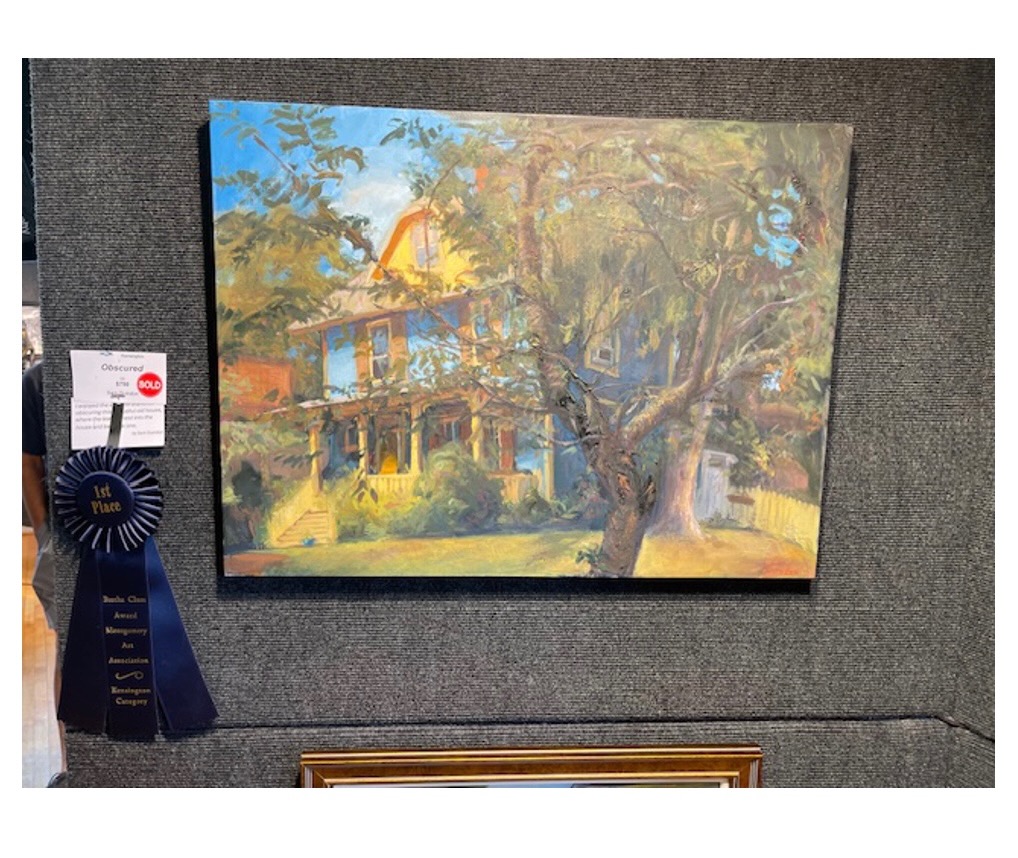
The largest prize each year is the Bertha Clum award for the best in the Kensington Category, paintings that are limited to Kensington landscapes. 

This year’s grand prize winner in the Kensington category was Sam Guindon’s “Obscured”, where the branches obscured this old house in Kensington.

Landscapes are defined as pictures showing natural or man-made scenery.  For example, they may show mountains, forests, beaches, skies, skyscrapers, and cities.  This show had a couple of paintings of cars that were classified as landscapes.  The main idea is that the setting is beautiful or interesting.  Landscapes greatly outnumbered the other categories of pictures at the exhibition.

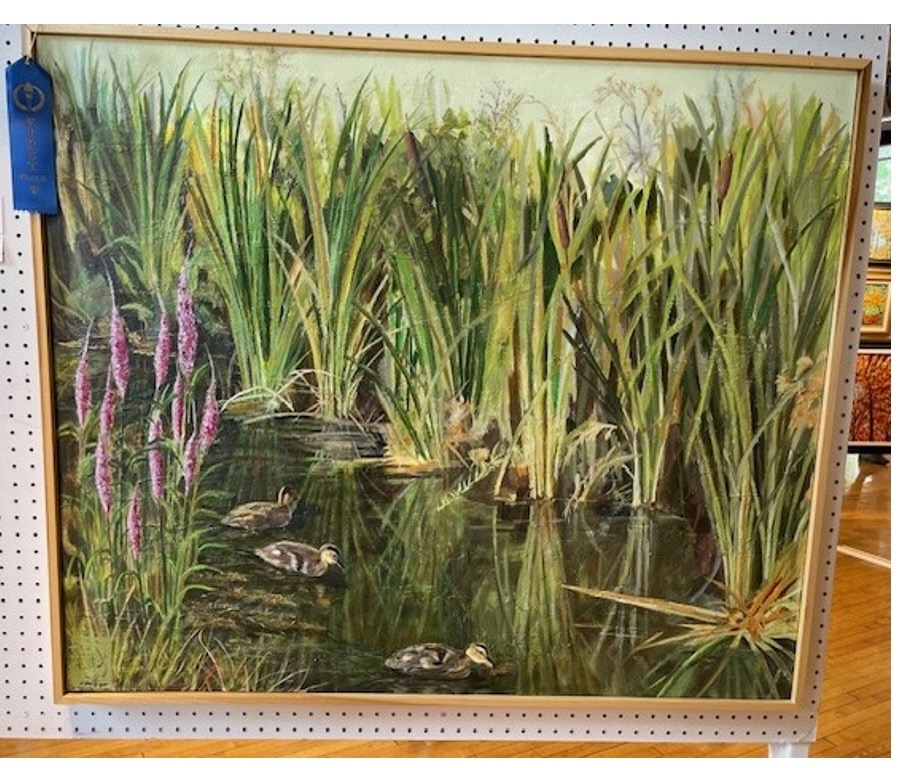
First Prize winner in Landscapes:  “No Rush in the Weeds”, an acrylic painting by Christina Haslinger.

To view Gerald’s entire report, including the winners in each of the other categories, go to this link.