PRA, Solar Energy

Update on Solar Power Program for Parkwood

[Gerald Sharp, PRA Treassurer, has published this update to his previous article on the Solar Switch program for Montgomery County].

In 2023 I took advantage of the Solar Switch program for Montgomery County in which  companies installing solar panels submit bids to install panels, and the program contracts with the lowest bidder that meets their requirements to get a group rate for solar installations.  I wrote up my experience with the program and the company, Lumina Solar in Baltimore, that won the contract that year and installed my panels in December 2023.  My article is available on the PRA website and now also on the Solar Switch website

At the end of 2024, Charlie Keyser, the Lumina Solar representative I had worked with, said that Lumina Solar could come close to meeting the Solar Switch price for 2024 (when they were not the low bidder and official chosen contractor), and Lumina Solar could give the PRA a $1000 referral fee for anyone we referred to them in January 2025.  I asked the PRA Executive Committee (EC) if it would be okay to keep just $100 of the referral fees and pay the balance to the residents installing solar panels, and the EC agreed.  Later when I started referring residents in Kensington Estates to the program, we decided to give $100 to their neighborhood organization and the balance to their residents who contracted with Lumina Solar.  Residents I referred in January 2025 were slated to receive $900; residents I referred before or after January 2025 were slated to receive $400 with the extra $100 going to either the PRA or the Kensington Estates Civic Association (KECA). 

So far, I have referred 15 residents of Parkwood and Kensington Estates to Lumina Solar, and 8 of those referrals were in January 2025, qualifying them for the $900 rebate from the PRA.  Of those 15 referrals, 6 residents have signed contracts with Lumina Solar (3 qualifying for $900 rebates and 3 qualifying for $400 rebates from the referral fees being paid to the PRA).   Two of the residents installing panels live in Kensington Estates, so the PRA will pay one of them $400 and the other one $900 with $200 going to KECA. 

Some residents who decided not to install solar panels had houses with too much shade from their trees to make the panels effective, but the most common reason residents had to not go forward was fear that the current 30% federal tax credit would be cancelled by the White House, and thus they would not get that substantial tax credit when they filed their taxes for 2025.  This is unlikely to happen, but some people don’t trust the administration not to cancel it. 

 According to the IRS, the 30% tax credit is available until 2032.   The credit is nonrefundable, so the credit amount you receive can’t exceed the amount you owe in tax, but you can carry forward any excess unused credit and apply it to reduce the tax you owe in future years.  Congress would have to agree to cancel it, and while this might happen in the future, it would be difficult to make any cancellation retroactive.  Thus, solar panels installed this year should qualify for the 30% tax credit when people file their 2025 federal taxes next year. 

Maryland previously offered a $1000 rebate to residents installing solar panels, but that program expired last November.  The state currently has a program to cover up to $7500 of the installation costs for middle income residents with “middle income” being defined as maximum gross yearly income of $128,430 for 1-person households, $147,715 for 2-, $165,090 for 3-, and $183,373 for 4-person households.  Information about this Maryland program is available at this link.

If you own an electric car or plan to buy one, Maryland also offers a rebate program for people who install Level 2 (dryer plug) outlets to charge their car.   The program, which currently is out of funds, will pay 50% of outlet installation costs up to $700.  Information about the program is here.  I had Lumina Solar install a Level 2 outlet when they installed my panels and received a check for $600 from the state. 

One Parkwood resident, Marc Goldstein, who decided to contract with Lumina Solar to install his panels, also received estimates from 5 other solar power installation companies.  Comparison of the bids he received gives us an opportunity to compare the various installation companies operating here.  Table 1 below shows the prices charged by Lumina Solar and the other five companies he contacted, along with other characteristics of the various bids.

Installation costs varied a lot on solar panel systems being installed locally.  Integrate Sun had the lowest total cost of $15,674 ($10,971 after the 30% federal tax credit), but their system was the only one using a single inverter for all the panels.  (Solar SME had the lowest final cost after their $5,800 rebate reduced it to $9,051.)  The other companies used more expensive systems with a microinverter installed for each panel separately.   Inverters convert the DC power generated by the sun into AC power.  Using microinverters for each panel allows them to operate independently, minimizing the impact of shading and panel failures on overall system output.  Nova Solar offered a discount of $6,450 for their installation, comparable to Solar SME’s $5,800 discount.  

Because I referred Marc to Lumina in January 2025, he qualified for the $900 PRA rebate from our referral fee.  Overall, there was a wider difference in the final cost estimates of each company than I would have expected.  Final cost estimates ranged from a low of $9,051 for Solar SME to the highest bid about twice as high for Palmetto at $19,349.  Payback periods also differed with the different companies, ranging from 4.4 years for Solar SME to 9.1 years for Palmetto.  However, this is an estimated number, because no one knows how much power companies will charge for electricity in the future, and the companies did not use the same rate increase estimates. 
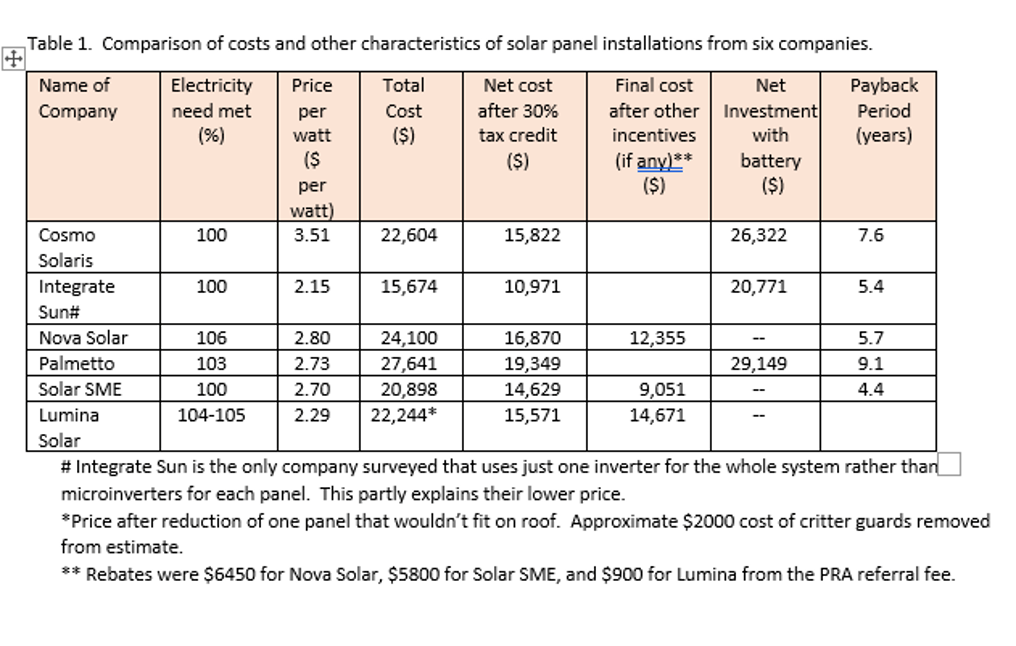
You will notice in Table 1 that the cost of installing a battery adds about $10,000 to the cost of the solar panel installations.  Marc and I decided not to install batteries when we contracted with Lumina Solar.  Maryland is a net metering state, meaning the state requires that when customers put excess power generated by their panels into the grid, they are credited by PEPCO and other power companies at the same price per kilowatt-hour (kWh) that they are charged.  This is not true in all states, because in some states the power companies are allowed to pay a lower rate for power put into the grid.  With net metering, the grid basically functions as a battery allowing the home owner to put excess power into the grid during the sunshine hours and pull it back out at night.  Thus, the $10,000 extra cost is harder to justify here. 

The downside is that during a power outage, PEPCO will turn off solar panel installations that lack batteries to avoid electrocuting their linemen.  If the home owner has a battery, PEPCO does not do this, thereby allowing solar panels to provide back-up power.  I decided that power outages here are too infrequent to justify the extra $10,000 cost.  Lumina Solar also offered Marc “critter guards”, basically a fence around the panels to keep animals from getting under them.  This was an additional $2000 charge, that I deducted from his cost estimate. 

Table 2 shows information about the number of panels and per panel costs, as well as information about the warranties offered by the 6 companies.  The companies surprised me in that the number of panels they planned to install differed so much, ranging from 14 to 25 panels.  I mean, after all, they were doing solar panel installations on the same house.   Solar SME with the lowest final cost of $9,051 planned to install 18 panels and discounted their price by $5,800.  Palmetto with the highest bid planned to install the most panels of any company at 25 and did not discount their price.  Marc said that Lumina Solar planned to install 21 panels, but they found during the installation that only 20 would fit on his roof, and his cost was decreased.  Thus, Palmetto’s plan to install 25 panels was probably not feasible. 
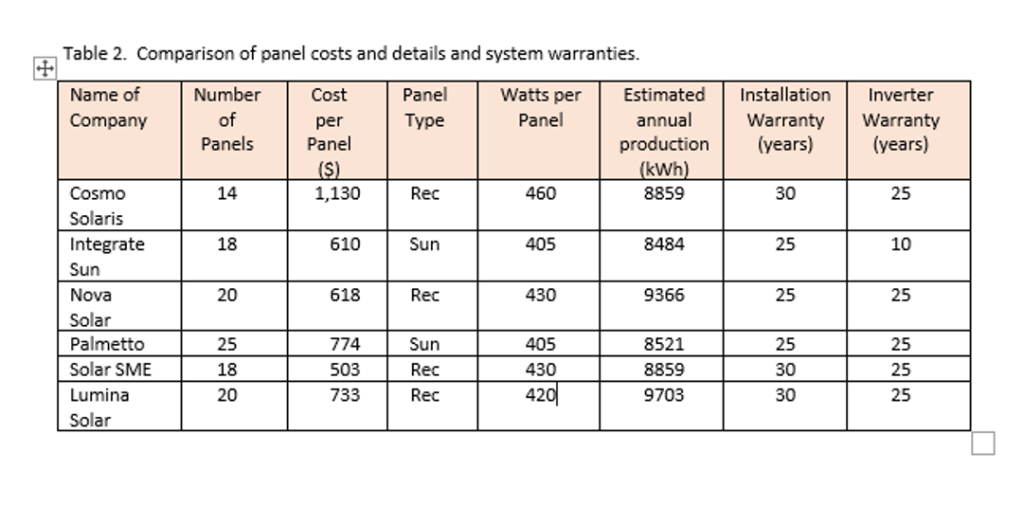
I was also surprised by the wide variation in the cost of each panel, which ranged from $503 for Solar SME with their large rebate to $1,130 for Cosmo Solaris.  Four of the companies used Rec panels, which are rated higher than the Sun panels offered by the other two companies.  Sun panels produce less watts per panel than Rec panels: 405 watts vs. 420-460 watts for Rec panels.  That difference and the difference in the numbers of panels being installed helps to explain the variation between companies in the estimated annual electricity production.  Cost per panel ranged from $503 to $1,130 for Rec panels and from $609 to $774 for Sun panels.

In terms of warranties, the six companies offered similar plans.   Warranties on installations were 25 years for Integrate Sun, Nova Solar, and Palmetto and 30 years for Cosmo Solaris and Solar SME.  Warranties on inverters were 25 years for all the companies except Integrate Sun at 10 years, the company that also was the low bidder for final costs.

In summary, the PRA’s program to facilitate adding solar power systems in Parkwood and Kensington Estates by returning most of Lumina Solar’s referral fee to residents here was moderately successful with a third of the people I referred to them opting to install panels.  If we had an administration that was more supportive of renewable energy, the PRA program might have been more successful with more people trusting that they would actually receive the current 30% federal tax credit for solar panel installations. 

In terms of the costs of solar power installations by companies operating here, there was a surprising difference in the estimates Marc received—both in price, number of panels to be installed, and cost per panel even though the panels being installed were very similar.  If you are thinking of installing solar panels, it is probably a smart idea to compare estimates from several companies before choosing a company to contract with, and be sure to ask them for any possible discounts.  Also consider taking advantage of the county’s Solar Switch program when it is offered again.  The PRA will continue to return most of the referral fees we get for referring people to Lumina Solar, which currently has $400 going to residents and $100 going to the PRA or KECA.  If you are interested in getting a free estimate, just let me know.

Gerald’s email: gbs2001@yahoo.com

Community Notes, MCCF, PRA

Parkwood’s Joe Harkins to be honored by the Montgomery County Civic Federation.

The Montgomery County Civic Federation [MCCF] will honor Parkwood’s Joe Harkins at its 100th Year Anniversary Celebration on June 8, 2025.  Joe will receive the Federation’s Star Cup, awarded to the Federation delegate or committee performing the most outstanding public service on behalf of Montgomery County.  The Federation itself will be celebrating its 100 years of community involvement and civic engagement on behalf of Montgomery County residents at the meeting. 

Joe is the chair of the PRA Civic Liaison Committee and one of the association’s official delegates to the MCCF.  Recognizing his legal experience and his diplomatic skills, the Federation asked Joe to chair its bylaws committee, which was tasked with updating its existing bylaws, last revised in 2013.  Joe and his committee did important and commendable work and the bylaws were overwhelmingly approved by the MCCF delegates at their April 2025 meeting.

Well done to Joe and congratulations on his award!

AHS, Housing, PRA

Status report on N.O.W. housing proposals

On Tuesday, April 8, 2025, the Montgomery County Council approved legislation and two zoning measures to incentivize the conversion of highly vacant office buildings into housing.  

Zoning Text Amendment (ZTA) 25-03 and Subdivision Regulation Amendment (SRA) 25-01 create an expedited approval process, and Bill 2-25 establishes a 20-year Payment in Lieu of Taxes (PILOT) for qualifying office to housing conversions that provide at least 17.5 percent affordable housing.  The provisions of the PILOT sunset in 10 years.

According to the Council’s press release, Montgomery County, like many jurisdictions, has an excess of commercial office space with vacancies.  At the end of 2024, the countywide office vacancy rate rose to 18.5 percent, double the previous year, with vacancies concentrated in older, functionally obsolete office buildings, which negatively impacts revenues and introduces blight into communities.  The County press release is here.

The remaining component of the More Housing N.O.W component is ZTA 25-02, which will be taken up in June after the Council completes the FY2025-26 budget.  This amendment allows duplexes, triplexes, townhouses, and apartment buildings in the R-40, R-60, R-90, and R-200 zones if along the following road types: Boulevard, Downtown Boulevard, Downtown Street, Town Center Boulevard, or Controlled Major Highway. For affordability, 15% of the units, with a minimum of 1 workforce housing unit if an application has at least 3 units, must meet the requirements for workforce housing, which is defined as at or below 120% average median income (AMI) in the County Code.  For more details see this PRA News article.

AHS, Housing, PRA

Housing Legislative Update: Governor’s Housing Bill Expires with General Assembly Session

On Monday/early Tuesday morning, April 7/8, Governor Moore’s Housing for Jobs Act, substantially rewritten in a House of Delegates committee, expired along with the General Assembly’s regular 2025 session. 

Although the House and Senate appeared to agree on the need for studies and reports on the housing market, as well as targets to increase housing in certain regions of the state, they stalled on language concerning “vesting rights” for developers. As proposed, such rights would have guaranteed housing developers the ability to proceed under zoning and permitting rules in place at the time of application and for five years thereafter. The bill did not move out of the Senate Education, Energy, and Environment Committee before the end of session.

Similar legislation is likely to be introduced next year. It is doubtful, however, that counties and municipalities will cede zoning and permitting authority to the state, as the first draft of HB 503/SB 430 appeared to contemplate. Thus, for Parkwood and surrounding neighborhoods, major legislative action on housing returns to the Montgomery County Council this year. Nevertheless, “politics is less local than it used to be.” Andrew Gelman, “All Politics is Local? The Debate and the Graphs,”  NYT, 03/21/15

Joe Harkins, Co-Chair, PRA Housing Committee

AHS, Housing, PRA

Housing: Further consideration of N.O.W. housing proposals postponed until June.

At the end of the Planning, Housing, and Parks [PHP] Committee work session on March 31, 2025, CM Friedson announced that because the Council was about to enter the budget season, it would not take up ZTA 2025-02 again until June. 

This  ZTA that will allow duplexes, triplexes, townhouses, and apartment buildings in the R-40, R-60, R-90, and R-200 zones if along the following road types: Boulevard, Downtown Boulevard, Downtown Street, Town Center Boulevard, or Controlled Major Highway. For affordability, 15% of the units, with a minimum of 1 workforce housing unit if an application has at least 3 units, must meet the requirements for workforce housing, which is defined as at or below 120% average median income (AMI) in the County Code.

To address the many issues raised by county residents at various hearings and listening session and by the Council and Planning Department staffs, the report accompanying the work session divided the issues into the following sections: (1) General (2) Corridors (3) Consolidation (4) Affordability (5) Development Standards (6) State and Federal Law (7) Impacts and (8) Technical and Other Amendments.

Of particular interest to many residents will be the staff responses to the 7 questions discussed in section (1) General, beginning on page 4 or the report.  These include:

  1. How much new housing supply is needed and based on what data?
  2. How many additional units do these proposals assume will be needed in the next 10 years to meet demand? How many housing units at what approximate price level does the Council anticipate these policies will generate?
  3. What is the development pipeline and why can it not achieve the County’s supply needs?
  4. What is the zoning text amendment (ZTA) process?
  5. Will notices be sent to effected property owners
  6. How will this ZTA be enforced?
  7. What is the difference between a master plan and a ZTA, and why are these changes being made through a ZTA?

The link to the full staff report is here.

AHS, Housing, PRA

LEGISLATIVE ALERT: Governor’s Housing Bill Weakened in Committee

This is an update on housing from Joe Harkins, Co-Chair of the PRA Housing Committee.

Governor Moore’s Housing for Jobs Act, HB 503, was recently overhauled and approved in the Maryland House of Delegates Committee on Environment and Transportation. PRA News previously reported on the potential for the bill, as originally drafted, to preempt county and local zoning and permitting requirements. At the urging of the Maryland Association of Counties, those provisions have now been removed. 

Instead, the committee draft now creates a housing commission to study the perceived housing crisis in the state and to make recommendations to increase affordable housing. The bill also provides for the Housing Secretary to set a 10-year target for housing production, including sub-targets by region. In addition, developers would be provided “vesting rights” such that, for five years after approval, projects must be governed by zoning and permitting requirements in effect at the time of application. An updated version of the Senate bill, SB 430, would have to be conformed to the House bill before final passage. 

Time may run out on any version of this legislation (by the April 7 end of session), but it would be unusual for a Governor’s Bill not to pass in some form, especially given the Democratic majorities in both chambers of the General Assembly.

AHS, Housing, PRA

LEGISLATIVE ALERT: Maryland General Assembly, proposed Housing for Jobs Legislation

The PRA Housing Committee, and its neighboring partner associations*, want to alert residents to legislation now pending before the Maryland General Assembly. The Housing for Jobs bills, HB 503 and SB 430, seek to accelerate county and municipality approvals of building permits in order to increase new housing.

The bills do so by identifying counties with a housing “deficit,” such that those counties would be required to expedite approvals of building permits unless a denial would fit six narrow exceptions. Even then, an exception can be overridden by “the need for more housing.” Montgomery County would be in the building deficit category until it achieves 33,000 new approvals, without regard to its current “pipeline” of some 35,000 housing permit approvals yet to be built. Under this formula, Montgomery County could remain in deficit indefinitely.

Under the proposed state legislation, in order for a county or local authority to deny new or substantially new housing permits, the authority would have to show, by clear and convincing evidence, that the housing would: adversely impact health or safety of occupants; fail to comply with other state or federal law; lack adequate water or wastewater facilities; be located on inappropriate land, such as industrial or agricultural space; cause local school enrollment to exceed 100% of capacity; not comply with objective written development standards in existence at the time of application.

Proponents of the legislation claim that this last exception preserves county and local zoning and permitting requirements. Opponents point out that the override for “the need for more housing” could preempt this and the other exceptions. In any event, traditional neighborhood considerations, such as traffic, parking and compatibility, do not figure into any of the provisions of the bill as currently proposed. 

The General Assembly is in session until April 7, 2025. Insiders in Annapolis expect substantial amendments to be advanced to these bills. But, due to the widespread perception of a housing crisis in the state, some form of the legislation is likely to be enacted by the General Assembly this year. We will update residents as the “sausage-making” progresses in the state capital.

*Kensington Estates Civic Association and Byeforde-Rock Creek Highlands Citizens Association.

AHS, Housing, PRA

Housing proposals:  Summary of Council Hearings and Next steps for NOW

This is an update from the Committee on Housing, a collaborative effort of the Parkwood Residents Association, the Kensington Estates Civic Association, and the  Byeforde-Rock Creek Highlands Citizens Association.

The Council has concluded its formal hearings on NOW, the group of proposals for addressing the County’s housing challenges.  Notes summarizing some of the residents’ pro and con statements at the hearings are here

Briefly stated, at the hearings residents who support NOW pointed to the significant need for more, and especially more affordable housing.  Opponents said that while the proposals may result in more housing, they have doubts that they will achieve the goal of affordability.  They also have concerns about the impact on the County’s schools and on its infrastructure for dealing with stormwater, increased traffic, and environmental impacts.

The County Executive and County Vice President Jawando have also expressed the need for more community engagement, such as occurs in the master planning process.

With six members of the Council already signed on as sponsors or cosponsors, it appears likely that some version of the current proposals will pass.  However, the Council is about to deal with the 2025/26 budget, which will undoubtedly take considerable time, especially given the uncertainties surrounding the impact of state and federal actions.  It is possible, therefore that final action on NOW might be deferred to later this year, possibly even into the fall. 

But for the moment, we should anticipate final action by the Council sometime in April or early May. 

NEXT STEPS

  • On March 24 at 6:30 p.m., the Montgomery County Civic Federation will host Councilmember Andrew Friedson for further discussion of More Housing NOW and housing future plans; the meeting is open to all.
  • The Zoom link is here.

Meeting ID: 823 1689 7559
Passcode: 424109 

  • On March 24 and 31, the County’s Planning, Housing, and Parks Committee [PHP] will hold work sessions on the proposed ZTAs and legislation.  More information about these work sessions is here.  When viewing this page, it is necessary to scroll down to see the agenda for the PHP committee on these dates.  Committee meetings are televised live on County Cable Montgomery or streamed live via this link .  Videos are archived and available on-demand 24 hours after the meeting concludes.

The PRA Housing Committee will post summaries of these sessions in PRA News on the listserv.

  • After the PHP work sessions are concluded, the committee will [presumably] pass the measures to the Council for final action.  This may include a Council work session before a final vote.
AHS, Housing, PRA

Town of Kensington Meeting on N.O.W. Housing Proposals

As previously reported in PRA News, the Town of Kensington will host a public meeting with Council President Kate Stewart (District 4), Councilmember Andrew Friedson (District 1), and Councilmember Natali Fani-Gonzalez (District 6) on new housing legislation entitled More Housing N.O.W., New Options for Workers

The meeting is open to the public and will be held both in-person at the Kensington Town Hall and also virtually on Zoom.  The zoom link is contained in this flyer from the town.  

Meeting date and time: Monday, March 3, 2025, from 7:00-8:30 p.m.

At our upcoming PRA winter meeting on February 24 we will have the opportunity to raise any questions about the N.O.W proposals so that we can forward them to the Councilmembers in advance of the Town Hall meeting on March 3.

AHS, Housing, PRA

Meetings on Housing Proposals

[This is an update from the PRA Housing Committee, formerly the PRA AHS Committee.] 

1. Public meeting on housing proposals with Councilmembers:  On Monday, March 3, 7-9:00 PM there will be a public meeting to discuss the new housing proposals with Councilmembers Friedson and Fani-Gonzalez (sponsors), and Council President Stewart (cosponsor).  [See this previous PRA News article.]  It will be both an in-person and a virtual meeting on Zoom hosted by the Town of Kensington at the town hall.  Parkwood residents are invited to join along with other Kensington residents associations.  The meeting will be recorded and made available on YouTube a few days later.  More details will follow when available.

2. PRA meeting agenda item on housing proposals. At our forthcoming PRA meeting on February 24 there will be an opportunity for residents to raise questions and voice their concerns about the proposals so that we can share them with Council President Stewart, as well as with Councilmembers Friedson and Fani-Gonzalez in advance of the meeting on March 3.

3. Issues raised.  Both the County Executive and the Montgomery County Civic Federation [MCCF] have raised questions about the new housing proposals. The MCCF has voiced concerns in a letter to the Council that there is inadequate time for residents to study the new proposals and  has requested that the Council postpone its public hearings currently scheduled for March 11 to a later date.  See the County Executive statement here and the MCCF letter here.

4. To testify or submit testimony. Anyone who may want to testify live [limited to three minutes] at the Council’s currently scheduled hearings on March 11 may sign up at this link [Go to the calendar for March 11 and select the 1:30 or 7:00 hearing time]. Testimony can also be submitted as a document, audio, or video file using this link.