This PRA newsletter from the Joint Housing Committee [JHC] contains three brief descriptions, obtained from a diverse set of sources, of HB239 and SB36, the housing legislation proposed by the Governor and being considered by the MD General Assembly. [See the previous newsletter for a description of the JHC.]
- The first description is from the County Council staff report submitted in preparation for a Council session that included a briefing on some of the housing legislation being considered by the General Assembly.
- The second description was prepared by the Montgomery County Civic Federation [MCCF]. For more from the MCCF see page 5 of their February 2026 newsletter.
- The third description is an AI prepared overview posted to the PRA listserv by Parkwood resident Anne Gagne.
1.Staff Report for Council Briefing on Governor’s Housing Package
Information on State Housing Legislation HB239/SB36 – Land Use – Zoning – Limitations
This bill applies to single family zones throughout the State and prohibits local jurisdictions (counties and municipalities) from enacting or enforcing laws that:
(1) establish minimum lot size for a single-family home greater than 5,000 square feet in areas served by municipal water and sewer;
(2) establish minimum dimensions, square footage, or lot coverage for a single-family home and any accessory structures;
(3) establish minimum setbacks greater than 5 feet (10 feet for front and back yards) for a single-family home;
(4) establish architectural, design, or aesthetic elements for a single-family home;
(5) prohibit the construction of town houses; and
(6) prohibit the owner of an improved lot from subdividing the lot into three or fewer similar lots. The bill specifies that it does not supersede building codes, fire codes, or public health and safety regulations that are necessary to address threats to public safety
The bill does not apply to: (1) an area designated as a historic preservation district before July 1, 2025; (2) agricultural land; or (3) conservation priority land.
Draft Maryland Association of Counties (MACo )Amendments
(1) Exempt all historic preservation districts.
(2) Exempt any area that is not connected to public water and sewer with sufficient capacity to support additional growth or not planned to be connected to public water and sewer within five years.
(3) Exempt counties with a population of less than 150,000 residents, not including residents within a municipality. The impact of this amendment is to make the bill applicable to eight counties (Montgomery, Prince George’s, Baltimore, Anne Arundel, Howard, Frederick, Harford, and Charles) and Baltimore City.
(4) Delete the prohibitions against local governments establishing setbacks and design, \architectural, and aesthetic standards.
(5) Specify that the bill does not supersede adequate public facilities laws or local equivalent density limits or allocations.
(6) Delay the effective date from October 1, 2026, to July 1, 2027, and impose a 10-year sunset.
2.Montgomery County Civic Federation Summary
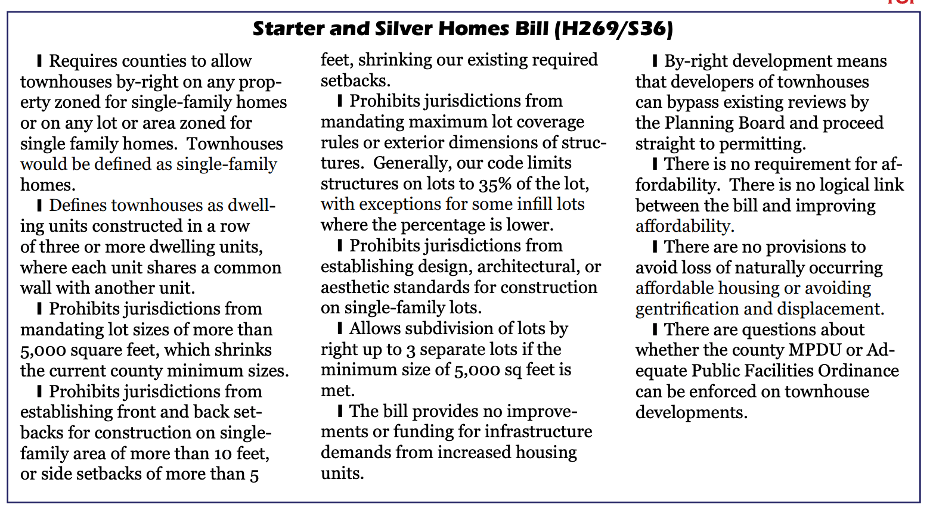
The goal of this bill is to increase the supply of market rate housing and foster greater density in neighborhoods primarily by restricting local authority. [Ed. note: The correct number of the House bill is HB239].
3. AI Generated Overview
The Maryland Starter and Silver Homes Act of 2026, part of Governor Wes Moore’s housing agenda, aims to increase affordable housing for first-time buyers and seniors.
It limits local zoning regulations on minimum lot sizes ( < 5000 sq ft), allowing smaller, more affordable homes (predicted as up to 30% less expensive) and townhouses in residential areas.
Key details of the Act include:
- Zoning Reform: Prohibits local governments from enforcing minimum lot sizes larger than 5,000 square feet, setting minimum square footage requirements, or restricting specific architectural styles.
- Density Increase: Enables the construction of townhouses in areas previously restricted to single-family homes and allows for the subdivision of existing lots.
- Target Demographic: Focuses on creating “starter” homes for younger professionals and “silver” homes for older adults looking to downsize and age in place.
- Goal: To address the state’s housing shortage by reducing costs for new buyers by up to 30 percent compared to current market options.
The legislation is designed to remove restrictive barriers that hinder the development of smaller, more affordable housing options.
Key Implications of the Proposal:
- Smaller Lot Sizes: Cities cannot mandate that a single-family lot be larger than 5,000 square feet (roughly 0.11 acres). This allows developers to fit more homes on a given piece of land, reducing land costs per unit.
- No Minimum Square Footage: Local governments cannot require houses to be a minimum size (e.g., forbidding small homes under 1,500 sq ft). This encourages the construction of “starter homes”.
- No Architectural Restrictions: Localities cannot restrict specific home styles or designs, allowing for modern, manufactured, or modular, and more diverse housing types.
- Focus on Infrastructure: These changes typically apply to areas served by, or planned for, municipal water and sewer, mitigating health concerns regarding high-density, septic-reliant development.
- Impact: Similar to reforms in Houston, this approach aims to reduce housing costs, create more “starter home” opportunities, and limit sprawl by promoting infill development.
This legislation addresses alleged “exclusionary zoning,” which has historically made it difficult to build lower-cost, smaller-footprint housing in many communities.

 Parkwood Residents Association