This article, prepared by the PRA AHS Committee, describes the Pattern Book as proposed in the Attainable Housing Strategies initiative which is being considered by the County Council. Previous articles covered the initiative’s Goals, the Impact on Types of Homes in Parkwood, and Priority Housing Districts. Please note that our Committee aims for objectivity and neutrality. Therefore, much of the text of this article is composed of direct quotes from the final report on the initiative.
“The Planning Board recommends creating a Planning Board-approved pattern book, to which conformance will be mandatory for the creation of new small scale attainable housing, whether through new construction or renovations to existing structures (emphasis added). The Pattern Book would apply to duplexes, triplexes, and quadplexes that could be built in Parkwood.
“The pattern book will be developed separately from the zoning recommendations through a process that will provide additional opportunities for community and stakeholder input. Work on the pattern book will proceed concurrently with the drafting of any zoning and subdivision text amendments based on direction from the Montgomery County Council.”
Because “the pattern book will be a complementary document to the development standards in the zoning ordinance, the Board recommends using a pattern book as part of the building permit process …to ensure clear and objective form-based standards.” Montgomery Planning and the Department of Permitting Services will partner to create a review process to ensure applicable development projects conform.” [pp30; dp31]
“The pattern book would apply to new construction … of standard method duplexes in the R-200, R-90, and R-60 zones, and new construction of standard method multiplexes in the R-90, R-60, and R-40 zones” [pp27; dp28**]. Parkwood is zoned R-60. Based on the criteria for “new construction” [see definition below], the proposed Pattern Book would evidently not affect additions or other changes to a single-family home remaining as a single-family home.
“The form-based standards within the pattern book will ensure that duplexes, triplexes, and quadplexes contribute positively to the public realm and create safe and attractive streetscapes that are not overwhelmed by parking or that unintentionally look like small apartment buildings.
“The pattern book will also ensure elements like porches, stoops, and lead walks are included to create neighborly homes that encourage social interaction and do not lead to isolating community dynamics. Finally, the pattern book will help eliminate arbitrary terms such as ‘character’ and ‘compatibility’ from the evaluation criteria for these duplex and multiplex building types and will rather focus on specific standards that achieve these more ambiguous goals.
“The pattern book will not dictate or restrict architectural styles, design choices, building materials, or colors. These creative choices will be the purview of the architect and/or homeowner. The pattern book will provide clear regulatory guidance with some conceptual options but will not create cumbersome mandates related to design. Thus, while allowing ample creative freedom, the pattern book will provide clear guidance to the architects and/or homeowners to construct house scale duplex and multiplex building types regardless of the size of the lot.” [pp28; dp29]
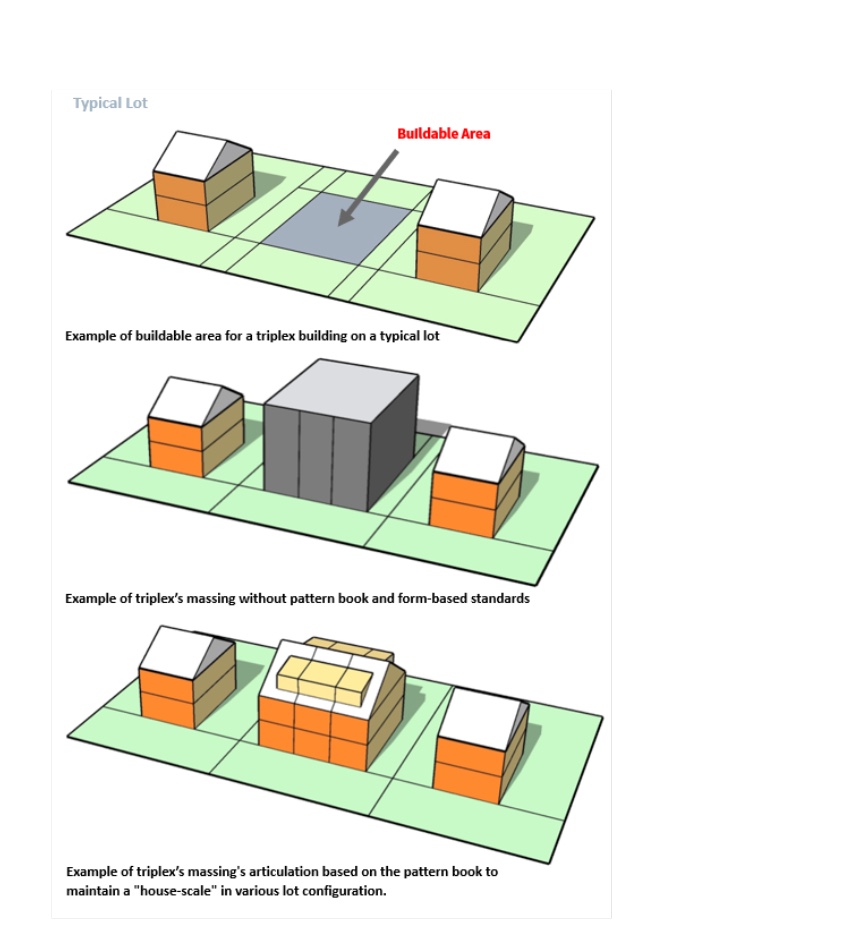
“Below is an illustration showing the development of a triplex on a typical lot found in many of the county’s neighborhoods. The first image shows the regulated buildable area, and the second image shows the “box” that can be built on the lot while adhering to typical regulatory requirements such as setbacks, lot coverage, and height. As demonstrated, the building envelope can create vastly different and potentially suboptimal results without form-based-standards [such as those in the Pattern Book]. The third image shows how the addition of some minimal form-based guidance (i.e., the Pattern Book) can create vastly superior outcomes.” [pp28; dp29]
The next article in this series will discuss how market factors might affect the rate at which single family homes would be turned into multi-unit houses if the AHS proposals are approved.
**************************************************
“Definition of new construction: “A new building, the demolition, and reconstruction of more than 50 percent of the floor area of an existing building, or the addition of more than 50 percent of the floor area to an existing building.” [pp27; dp28**]
** Throughout this and subsequent articles, two page numbers will be used as references to the text of the Planning Board’s Final Report to the Council. The letters “pp” will refer to the printed page number of the report. The letters “dp” will refer to the digital page number of the report in PDF format.

 Parkwood Residents Association
Nice summary of what the pattern books are aiming to accomplish, and good that they will be available at the time the zoning issue is being considered, and not much later. The sample construction paints a rosy picture of the lack of effect of the new building on the adjacent ones, which are pictured to be relatively large.The new building would no doubt cut off light from the adjacent buildings if coming from another direction.
The main issue is parking. The plans in what’s been presented so far are figuring on one car per dwelling (2 car parking spots for duplex, 3 for triplex, and 4 for quadplex). Quadplexes are permitted within 1 mile as crow flies from Grosvenor Metro Station or the MARC station in Kensington, which includes most of Parkwood. Do we have sufficient parking room on the street for people who have more than one car per family?